Improper Integral Notation

Jason76

Senior Member
Joined
Oct 19, 2012
Messages
1,180
What does

\(\displaystyle \epsilon\)

\(\displaystyle 1 + \epsilon\)

\(\displaystyle 1 - \epsilon\)

\(\displaystyle 1 + \delta\)

mean in these situations? Goal is not to solve, but just explain notation

a.

\(\displaystyle \int_{1}^{2} \dfrac{dx}{\sqrt{x - 1}}\)

discontinuity at \(\displaystyle x = 1\)

\(\displaystyle \lim \epsilon \rightarrow 0^{+} \int_{1 + \epsilon}^{2} \dfrac{dx}{\sqrt{x - 1}}\)

b.

\(\displaystyle \int_{1}^{0} x \ln x dx\)

discontinuity at \(\displaystyle x = 0\)

\(\displaystyle \lim \epsilon \rightarrow 0^{+} \int_{\epsilon}^{1} x \ln x dx\)

c.

\(\displaystyle \int_{0}^{2} \dfrac{dx}{(x -1)^{2}}\)

discontinuity at \(\displaystyle x = 1\)

\(\displaystyle \lim \epsilon \rightarrow 0^{+} \int_{0}^{1 - \epsilon} \dfrac{dx}{(x - 1)^{2}} + \lim \delta \rightarrow 0+ \int_{1 + \delta}^{2} \dfrac{dx}{(x - 1)^{2}}\)

:confused:
 
Last edited:
What does

\(\displaystyle \epsilon\)

\(\displaystyle 1 + \epsilon\)

\(\displaystyle 1 - \epsilon\)

\(\displaystyle 1 + \delta\)

mean in these situations? Goal is not to solve, but just explain notation
They don't mean anything without some definition but typically we are given \(\displaystyle \epsilon\) and \(\displaystyle \delta\) as very small numbers. Assuming that, \(\displaystyle 1+ \epsilon\) and \(\displaystyle 1+ /delta\) are numbers slightly larger than 1 and \(\displaystyle 1- \epsilon\) is a number slightly less than 1.

a.

\(\displaystyle \int_{1}^{2} \dfrac{dx}{\sqrt{x - 1}}\)

discontinuity at \(\displaystyle x = 1\)

\(\displaystyle \lim \epsilon \rightarrow 0^{+} \int_{1 + \epsilon}^{2} \dfrac{dx}{\sqrt{x - 1}}\)
Because of the discontinuity at x= 1 (the denominator of the integrand is 0), We cannot simply evaluate the anti-derivative at x= 1. Instead, we take the limit as x goes to 1.

b.

\(\displaystyle \int_{1}^{0} x \ln x dx\)

discontinuity at \(\displaystyle x = 0\)

\(\displaystyle \lim \epsilon \rightarrow 0^{+} \int_{\epsilon}^{1} x \ln x dx\)
ln(x), and so x ln(x), is not defined at x= 0. Therefore, we must take the limit of the anti-derivative as x goes to 0 rather than simply evaluate it at x= 0. We take the limit from "slightly above 1" and then "sneak" down to 1.

(Did you really mean the integral from 1 to 0? If so then it is \(\displaystyle \lim_{\epsilon\to 0}\int_1^\epsilon x\ln(x)dx= - \lim_{\epsilon\to 0}\int_\epsilon^1 x \ln(x) dx\))

c.

\(\displaystyle \int_{0}^{2} \dfrac{dx}{(x -1)^{2}}\)

discontinuity at \(\displaystyle x = 1\)
Once again we have denominator equal to 0 at x= 1 so we take the integral from 0 up to slightly below 1, then from slightly above 1 to 2, then take the limit, on the first integral, going to 1 from below and, on the second integral, going to 1 from above.

\(\displaystyle \lim \epsilon \rightarrow 0^{+} \int_{0}^{1 - \epsilon} \dfrac{dx}{(x - 1)^{2}} + \lim \delta \rightarrow 0+ \int_{1 + \delta}^{2} \dfrac{dx}{(x - 1)^{2}}\)

:confused:
 
Last edited:
What does
\(\displaystyle \epsilon\) \(\displaystyle 1 + \epsilon\) \(\displaystyle 1 - \epsilon\) \(\displaystyle 1 + \delta\)
mean in these situations? Goal is not to solve, but just explain notation
a. \(\displaystyle \int_{1}^{2} \dfrac{dx}{\sqrt{x - 1}}\)

discontinuity at \(\displaystyle x = 1\)

\(\displaystyle \lim \epsilon \rightarrow 0^{+} \int_{1 + \epsilon}^{2} \dfrac{dx}{\sqrt{x - 1}}\)

All of these are related to the topic of improper integrals. You need to lookup the topic.

The idea is that \(\displaystyle \int_0^4 {\frac{{dx}}{{{{(x - 2)}^2}}}} \) is improper because the intergrand has a discontinuity on \(\displaystyle [0,4]\) namely at \(\displaystyle x=2\).

But is these limits exist \(\displaystyle \displaystyle{\lim _{a \to {2^ - }}}\int_0^a {\frac{{dx}}{{{{(x - 2)}^2}}} + } \)\(\displaystyle \displaystyle{\lim _{b \to {2^ + }}}\int_b^4 {\frac{{dx}}{{{{(x - 2)}^2}}}} \) then we say the original integral is equal to that limit.
 
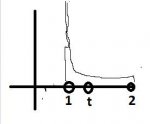
For a, it seems like you could replace 1 with t and still get the same answer. Is the \(\displaystyle 1 + \epsilon\) necessary? Iv'e looked at several YouTube vids and I haven't seen epsilon mentioned.

t would approach 1 from the right.

graph.jpg
 
Last edited:
For a, it seems like you could replace 1 with t and still get the same answer.

Not "replace 1 with t" but replace \(\displaystyle 1+ \epsilon\) with t. It is true that
\(\displaystyle \lim_{\epsilon\to 0^+}\int_{1+\epsilon}^2 \frac{dx}{\sqrt{1- x^2}}= \lim_{t\to 1^+}\int_t^2 \frac{dx}{\sqrt{1- x^2}}\)
 
Last edited:
Not "replace 1 with t" but replace \(\displaystyle 1+ \epsilon\) with t. It is true that
\(\displaystyle \lim_{\epsilon\to 0^+}\int_{1+\epsilon}^2 \frac{dx}{\sqrt{1- x^2}}= \lim_{t\to 1^+}\int_t^2 \frac{dx}{\sqrt{1- x^2}}\)

\(\displaystyle 1 + \epsilon\) is confusing cause I don't understand it's meaning. But I do with \(\displaystyle t\).

For b. \(\displaystyle t\) would approach \(\displaystyle 0\) from the left.

For c. \(\displaystyle t\) would approach \(\displaystyle 1\) from the left and right. t would be involved in two limits which would be added. But if only one is found to be divergent, then you don't have to find the limit of the other one.
 
Last edited:
\(\displaystyle 1 + \epsilon\) is confusing cause I don't understand it's meaning.

I do agree with you. It is confusing. So do not use.

But it is simple to understand. Fact: \(\displaystyle \displaystyle{\lim _{x \to {1^ + }}}f(x) = {\lim _{\varepsilon \to {0^ + }}}f(1 + \varepsilon )\)

It really is historical in origin.
\(\displaystyle \varepsilon \) was used as an infinitesimal historically.
And still is today by non-standard analysts.
If simply means \(\displaystyle 1 + \varepsilon \approx 1\); a number that is not one but is very close to one.
 
I do agree with you. It is confusing. So do not use.

But it is simple to understand. Fact: \(\displaystyle \displaystyle{\lim _{x \to {1^ + }}}f(x) = {\lim _{\varepsilon \to {0^ + }}}f(1 + \varepsilon )\)

It really is historical in origin.
\(\displaystyle \varepsilon \) was used as an infinitesimal historically.
And still is today by non-standard analysts.
If simply means \(\displaystyle 1 + \varepsilon \approx 1\); a number that is not one but is very close to one.

But if you do algebra with it (gamma or epsilon), it comes out with the same answer, as if you had used \(\displaystyle t\), or some other single variable.
 
a infinitesimal that \(\displaystyle \epsilon^2\) and higher order terms are discardable, i.e. just assume them to be 0. You wouldn't do that with a variable that isn't an infinitesimal.

There is a small correction to that. In non-standard analysis actually that is quite the opposite to the case.

In Elementary Calculus: An Infinitesimal Approach
In Elementary Caculus: An Infinitesimal Approach by Jerome Keisler in chapter 1, there is good argument for this. The chapters and whole book is a free down-loadat http://www.math.wisc.edu/~keisler/calc.html.

While zero is an infinitesimal, not all infinitesimals are zero.

\(\displaystyle \varepsilon \) is an infinitesimal if \(\displaystyle \forall x\in\mathbb{R}^+ \) it is the case that \(\displaystyle \left| \varepsilon \right| < x\).
The axiom is that there is a non-zero infinitesimal.
 
Last edited:
Top