Integral problem, help asap please, I am stuck

Hello I have been trying to do this one but I am stuck:


Check that x = e ^ (5x sin (3x)) satisfies the differential equation
y`` - 3y` - y - 21e^(5x) cos(3x)=0


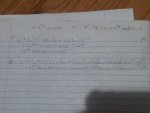
http://i.minus.com/iecopUpDEbdvP.jpgView attachment 3462

Your second derivative seems messier than it needs to be.

Mathematica gets

\(\displaystyle 2 e^{5 x} (8 \sin (3 x)+15 \cos (3 x))\)

see if you can replicate this and then solve the problem.
 
Your second derivative seems messier than it needs to be.

Mathematica gets

\(\displaystyle 2 e^{5 x} (8 \sin (3 x)+15 \cos (3 x))\)

see if you can replicate this and then solve the problem.
I got it :)
Will post maybe a last one if I can't do it.

Thank you.
 
You shouldn't have to use "Mathematica" or any other computer system to do this.

\(\displaystyle y= e^{5xsin(3x)}\) so the first derivative is \(\displaystyle e^{5x sin(3x)}\) times the derivative of \(\displaystyle 5x sin(3x)\) which, by the product rule, is \(\displaystyle 5 sin(3x)+ 15x cos(3x)\). That is \(\displaystyle y'= (5 sin(3x)+ 15x cos(3x))e^{5x sin(3x)}\).

To find the second derivative, use the product rule again. The derivative is \(\displaystyle 15 cos(3x)+ 15 cos(3x)- 45x sin(3x)= 30cos(3x)- 45x sin(3x)\) times \(\displaystyle e^{5x sin(3x)}\) plus \(\displaystyle 30cos(3x)- 45 sin(3x)\) times the derivative of \(\displaystyle e^{5x sin(3x)}\) which is the same as before: \(\displaystyle y''= (30 cos(3x)- 45 sin(3x))e^{5x sin(3x)}+ (5 sin(x)+ 15cos(x))^2e^{5x sin(3x)}\).
 
You shouldn't have to use "Mathematica" or any other computer system to do this.

\(\displaystyle y= e^{5xsin(3x)}\) so the first derivative is \(\displaystyle e^{5x sin(3x)}\) times the derivative of \(\displaystyle 5x sin(3x)\) which, by the product rule, is \(\displaystyle 5 sin(3x)+ 15x cos(3x)\). That is \(\displaystyle y'= (5 sin(3x)+ 15x cos(3x))e^{5x sin(3x)}\).

To find the second derivative, use the product rule again. The derivative is \(\displaystyle 15 cos(3x)+ 15 cos(3x)- 45x sin(3x)= 30cos(3x)- 45x sin(3x)\) times \(\displaystyle e^{5x sin(3x)}\) plus \(\displaystyle 30cos(3x)- 45 sin(3x)\) times the derivative of \(\displaystyle e^{5x sin(3x)}\) which is the same as before: \(\displaystyle y''= (30 cos(3x)- 45 sin(3x))e^{5x sin(3x)}+ (5 sin(x)+ 15cos(x))^2e^{5x sin(3x)}\).

would you hammer a nail in with your fist? No? Then don't harp on me using mathematica to do algebra and derivatives. The guy worked the problem and made a small error. Rather than spend 30 minutes, of my fairly valuable time trudging through it I used mathematica to quickly find the error.

If you have a problem with that you should really re-evaluate why you are here.
 
would you hammer a nail in with your fist?

No? Then don't harp on me using mathematica to do algebra and derivatives. The guy worked the problem and made a small error. Rather than spend 30 minutes, of my fairly valuable time trudging through it I used mathematica to quickly find the error.

If you have a problem with that you should really re-evaluate why you are here.

I think HoI was NOT trying to berate you anyway. Not everybody has access to Mathematica (well its baby cousin wolframalfa is)- so I believe he was pointing out to the student that this can be solved without technology.

About the fist and the hammer though - you pulled out a nail-gun. I teach basic engineering. I do want my students to work through the differentiation and messy algebra - it builds character. In this case character being - meticulousness, clean presentation, logical step-by-step thinking and a bit of self-confidence (I don't need no stinkin' software to tell me the derivative). Perhaps nothing to do with Math - but a lot to do with"workplace".

I do understand that you said, you used Mathematica - and - did not advocate use of Mathematica to the student to do the problem. I also advice my students to check their answer using Wolframalfa. But I insist that they show intermediate steps - like HoI did.
 
Not being a teacher, but having many years' experience in various workplaces, I find this argument interesting.

There are now tools that allow much of the mechanical aspects of math to be done with little human effort. No one would have asked me to study science without a slide rule. And no one in the business world tries to do a lot of arithmetic without an adding machine, a calculator, or a spreadsheet. It is fruitless to insist that students eschew the labor saving devices now available, labor saving devices that they will be expected to utilize effectively in the workplace.

Assuming anyone considered my opinions on pedagogy worth considering, I would take advantage of the tools now available to spend much more teaching time on concepts and word problems, which require figuring out what concepts to apply. What is worrisome, however, about tools, formulas, rules, etc. is that, without understanding, it is very easy to apply the wrong one to a specific problem. One of the things done well by mechanical problems such as what is the derivative of this function is making concepts concrete and thereby solidifying understanding. So I would still devote time (just less time) to solving mechanical problems without utilizing black boxes. But such mechanics are not the essence of math. Do any of us here think that Jason, no matter how diligent he is about learning rules and how careful he is about neat presentation, will ever be able to apply calculus?

 
The main problem I find is similar to that of using GPS for every trip. We loose our instincts of watching landmarks and when GPS gives up due to poor satellite reception in Downtown St. Louis - we are in real trouble.

I believe that - at least going through BS - we are "developing" our instincts. We may choose to quash those later - but for the time being I vote for developing instincts, pattern recognition, etc.

If I am suddenly trapped in a traffic-jam - or need to choose a path I have not traveled before within a "real" time constraint - I do use my GPS (which is running). However, before making any new trip - I sit down with my trusty map and get a fix on my destination - approximate distance - turns - land marks.

I solve problem similar way - I try to teach "problem-solving" similar way. Just because solution manual is published and the students can get hold of that - I strongly discourage "copying" the solution down. The intent of the test was not to provide me with the answer - the intent was to find the route and travel the route without the help of "somebody else" (technology in disguise) or walking the route for you.
 
Subhotosh Khan

I am not sure whether we are disagreeing or not. I agree that black box "thinking" is often not thinking at all. I am partially saying that it is unrealistic not to teach people how to use tools that are readily available: they will use them anyway and, in practice, will be expected to use them proficiently. Why go through the drudgery of multiplying by hand if a slide rule or calculator is handy? But I am qualifying that by also saying that some training in doing what the black box does is necessary because if you do not understand "what" the black box is doing you may not know when to avoid the black box. Using a slide rule to add numbers is inadvisable. But I am also saying that improved black boxes have the positive benefit of permitting more time to be spent on problems that involve determining what concepts apply and translating problems into mathematical form. Formulating the right equation is more important, to me at least, than the mechanics of using Newton's method to find its roots.
 
Subhotosh Khan ... Using a slide rule to add numbers is inadvisable.

That reminds me of a story:

Noah's boat finally comes to rest as the flood waters recede, and he lowers the gangway and send the animals out calling to them, "Go forth and multiply".

Most of the animals leave, but two snakes are left behind. Noah looks at them, and commands "Go forth and multiply!"

The snakes look at him but do not move. He tries again, "Go forth and multiply!" The snakes do not move.

Noah gets angry and in his most commanding voice shouts, "Go forth and multiply!"

The snakes look up at him and say, "We can't, we're adders".

Noah thinks for a while, then grabs his saw and hammer and runs off into the forest, where he cuts down a tree. He saws and hammers and builds a small table. He carefully picks up the snakes and puts them on the table.

"Here is a log-table ..... now go forth and multiply!" he commands.
 
Top