integrate 1/(sqrt(x^2+8x+25))

Lividtea

New member
Joined
Apr 13, 2015
Messages
6
Hi,

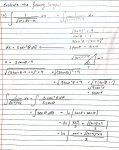
I feel like I'm doing everything correct, but when I double check with wolfram, they had a different answer. Any input would be appreciated. If you don't understand my work, please feel free to ask for clarifications. I don't mind re-writing my work so it's easier to follow.

attachment.php


this is wolfram's answer:
attachment.php
 

Attachments

  • rU21bQ7b3fSKWYQaWVr6ECg1.t1024u.jpg
    rU21bQ7b3fSKWYQaWVr6ECg1.t1024u.jpg
    151.5 KB · Views: 62
  • Capture.JPG
    Capture.JPG
    36.5 KB · Views: 49
Hi,

I feel like I'm doing everything correct, but when I double check with wolfram, they had a different answer. Any input would be appreciated. If you don't understand my work, please feel free to ask for clarifications. I don't mind re-writing my work so it's easier to follow.

attachment.php


this is wolfram's answer:
attachment.php


You are correct and Wolfram is correct. Both expressions are equivalent.
 
I'd just like to add a bit of clarification, in case you were wondering how Wolfram Alpha got to their answer. In my Calculus textbook (possibly in yours too, I don't know), we're given formulas for the derivatives of the hyperbolic trig functions and their inverses. The relevant one is:

\(\displaystyle \frac{d}{dx}\left(sinh^{-1}\left(x\right)\right)=\frac{1}{\sqrt{x^2+1}}\)

And from that, we get:

\(\displaystyle \int \frac{1}{\sqrt{x^2+1}}dx=sinh^{-1}\left(x\right)+C\)

So, starting from your integral, we'll do u-substitution. Let u = (x+4) and du = dx

\(\displaystyle \int \frac{1}{\sqrt{\left(x+4\right)^2+9}}dx\)

\(\displaystyle \int \frac{1}{\sqrt{u^2+9}}du\)

\(\displaystyle \int \frac{1}{\sqrt{\frac{u^2}{9}+1}}du\)

\(\displaystyle \int \frac{1}{\sqrt{\left(\frac{u}{3}\right)^2+1}}du\)

And there we have a form of the integral that looks like the one of inverse hyperbolic sine. So, the integral must evaluate to:

\(\displaystyle \int \frac{1}{\sqrt{\left(\frac{u}{3}\right)^2+1}}du=sinh^{-1}\left(\frac{u}{3}\right)+C\)

Since u = (x+4), we plug that back in and get Wolfram's form of the answer:

\(\displaystyle sinh^{-1}\left(\frac{u}{3}\right)+C=sinh^{-1}\left(\frac{x+4}{3}\right)+C\)

But, as Subhotosh Khan said, your answer is also correct. It's just a different way of solving the integral, and a different way of writing the answer.
 
Top