
L Lil_yoyobo needs help New member Joined Feb 2, 2020 Messages 3 Feb 2, 2020 #1 Determine if the inverse of f(x) = "the attached picture" is a function. Then find the inverse. My confusion is how do I solve this since there is a negative cube root and I don't know how to solve this problem because of that.
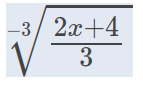
Determine if the inverse of f(x) = "the attached picture" is a function. Then find the inverse. My confusion is how do I solve this since there is a negative cube root and I don't know how to solve this problem because of that.
Steven G Elite Member Joined Dec 30, 2014 Messages 14,603 Feb 2, 2020 #2 The negative in the root tells you to take the reciprocal. For example (x/(x+2))-2/3 = ((x+2)/x)2/3 \(\displaystyle \sqrt[-3]{a} = \dfrac{1}{\sqrt[3 ]{a}}\) Last edited: Feb 2, 2020
The negative in the root tells you to take the reciprocal. For example (x/(x+2))-2/3 = ((x+2)/x)2/3 \(\displaystyle \sqrt[-3]{a} = \dfrac{1}{\sqrt[3 ]{a}}\)
L Lil_yoyobo needs help New member Joined Feb 2, 2020 Messages 3 Feb 3, 2020 #3 Jomo said: The negative in the root tells you to take the reciprocal. For example (x/(x+2))-2/3 = ((x+2)/x)2/3 \(\displaystyle \sqrt[-3]{a} = \dfrac{1}{\sqrt[3 ]{a}}\) Click to expand... Thank you for your time! I got it now. Ye
Jomo said: The negative in the root tells you to take the reciprocal. For example (x/(x+2))-2/3 = ((x+2)/x)2/3 \(\displaystyle \sqrt[-3]{a} = \dfrac{1}{\sqrt[3 ]{a}}\) Click to expand... Thank you for your time! I got it now. Ye