
Linear Programming

pinkzepp

New member
Joined
Dec 16, 2013
Messages
2
Hi, I'm getting stuck on some linear programming and how the question has been put forth. I'm actually OK with linear programming graphing, finding the extreme points, and optimal solution and optimal value when the question is put as this:


Maximise 2x1 + 5x2
subject to
x1 <= 8x2 <= 10

2x1 + 4x2 <= 40

x1, x2 => 0


But I can’t figure out with the example below because of how it is being asked. I can’t work out all the constraint lines for the graph, i think. I can get the diagonal line from 4x1 + 2x2 <= 12, but not the x2 and x1

Find numbers x1 and x2 that maximise the sum x1 + x2 subject to the constraints:

x1 => 0, x2 => 0, and


x1 + 2x2 <= 4 with this i can see that two points might be x1=0 & x2=2

4x1 + 2x2 <= 12 with this one i'm confident in that x1=3 and x2=6

-x1 + x2 <= 1 no idea with this line other than indicating that some points may be negative on the graph.

So essentially i'm not able to graph this one, once I can see how it is graphed the putting it into a table and working out the rest should be ok...

If you need me to explain more in detail just let me know and should be able to sort it out.

Thanks,
 
Hi, I'm getting stuck on some linear programming and how the question has been put forth. I'm actually OK with linear programming graphing, finding the extreme points, and optimal solution and optimal value when the question is put as this:


Maximise 2x1 + 5x2
subject to
x1 <= 8x2 <= 10

2x1 + 4x2 <= 40

x1, x2 => 0


But I can’t figure out with the example below because of how it is being asked. I can’t work out all the constraint lines for the graph, i think. I can get the diagonal line from 4x1 + 2x2 <= 12, but not the x2 and x1

Find numbers x1 and x2 that maximise the sum x1 + x2 subject to the constraints:

x1 => 0, x2 => 0, and


x1 + 2x2 <= 4 with this i can see that two points might be x1=0 & x2=2.. Points below the line x2 = - (1/2) * x1 + 2 ......... corrected
4x1 + 2x2 <= 12 with this one i'm confident in that x1=3 and x2=6.. Points below the line x2 = - 2x1 + 6

-x1 + x2 <= 1 no idea with this line other than indicating that some points may be negative on the graph... Points below the line x2 = x1 + 1

Assuming that x1 is abcissa and x2 is the ordinate, all you points must be above x2 = 0 line (abcissa) and to the right of x1 = 0 line (ordinate)

So essentially i'm not able to graph this one, once I can see how it is graphed the putting it into a table and working out the rest should be ok...

If you need me to explain more in detail just let me know and should be able to sort it out.

Thanks,
.
 
Last edited by a moderator:
Hi, I'm getting stuck on some linear programming and how the question has been put forth. I'm actually OK with linear programming graphing, finding the extreme points, and optimal solution and optimal value when the question is put as this:


Maximise 2x1 + 5x2
subject to
x1 <= 8x2 <= 10

2x1 + 4x2 <= 40

x1, x2 => 0


But I can’t figure out with the example below because of how it is being asked. I can’t work out all the constraint lines for the graph, i think. I can get the diagonal line from 4x1 + 2x2 <= 12, but not the x2 and x1

Find numbers x1 and x2 that maximise the sum x1 + x2 subject to the constraints:

x1 => 0, x2 => 0, and


x1 + 2x2 <= 4 with this i can see that two points might be x1=0 & x2=2

4x1 + 2x2 <= 12 with this one i'm confident in that x1=3 and x2=6

-x1 + x2 <= 1 no idea with this line other than indicating that some points may be negative on the graph.

So essentially i'm not able to graph this one, once I can see how it is graphed the putting it into a table and working out the rest should be ok...

If you need me to explain more in detail just let me know and should be able to sort it out.

Thanks,
Thank you for sharing your thoughts instead of just presenting a problem.

The part of the line that shows negative values is irrelevant. That does not make the entire line irrelevant. Does the light click on now?
 
IMAG0363.jpgIMAG0364.jpg

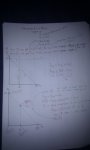
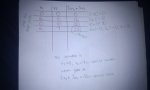
The pictures, if you are able to view them bigger, are of a very similar question which i understand, but not sure that I can use that method for the one i am getting stuck on.

Thanks for the replies. No the light hasn't quite switched on yet, if it has it is very dim...

Yes, I think Khan you are right in saying that x1 is the horizontal line and x2 is the vertical line. However, I can't quite understand how you got to those answers as I guess I've been shown a different way to do it. For the 4x1 + 2x2 <= 12 I was shown like this by dividing each x by the constraint.

  • If x1 = 0, we get 2x2 = 12, so x2 = 6
  • If x2 = 0, we get 4x2 = 12, so x1 = 3
from this i know that i can get one of the co-ordinates, that being 6.

I don't think I follow in how you got +4 as my thinking was you had to divide it.

x1 + 2x2 <= 4
with this i can see that two points might be x1=0 & x2=2.. Points below the line x2 = - x1 + 4


Find numbers x1 and x2 that maximise the sum x1 + x2 subject to the constraints:

x1 => 0, x2 => 0, and


x1 + 2x2 <= 4 with this i can see that two points might be x1=0 & x2=2.. Points below the line x2 = - x1 + 4

4x1 + 2x2 <= 12 with this one i'm confident in that x1=3 and x2=6.. Points below the line x2 = - 2x1 + 6

-x1 + x2 <= 1 no idea with this line other than indicating that some points may be negative on the graph... Points below the line x2 = x1 + 1
 
Both the regions "\(\displaystyle ax+ by\le c\)" and "\(\displaystyle ax+ by\ge c\)" have the line \(\displaystyle ax+ by= c\) as boundary.
 
View attachment 3530View attachment 3531

The pictures, if you are able to view them bigger, are of a very similar question which i understand, but not sure that I can use that method for the one i am getting stuck on.

Thanks for the replies. No the light hasn't quite switched on yet, if it has it is very dim...

Yes, I think Khan you are right in saying that x1 is the horizontal line and x2 is the vertical line. However, I can't quite understand how you got to those answers as I guess I've been shown a different way to do it. For the 4x1 + 2x2 <= 12 I was shown like this by dividing each x by the constraint.

  • If x1 = 0, we get 2x2 = 12, so x2 = 6
  • If x2 = 0, we get 4x2 = 12, so x1 = 3
from this i know that i can get one of the co-ordinates, that being 6.

I don't think I follow in how you got +4 as my thinking was you had to divide it.

x1 + 2x2 <= 4
with this i can see that two points might be x1=0 & x2=2.. Points below the line x2 = - (1/2) * x1 + 2 .......... there was a mistake - corrected it

Find numbers x1 and x2 that maximise the sum x1 + x2 subject to the constraints:

x1 => 0, x2 => 0, and


x1 + 2x2 <= 4 with this i can see that two points might be x1=0 & x2=2.. Points below the line x2 = - x1 + 4

4x1 + 2x2 <= 12 with this one i'm confident in that x1=3 and x2=6.. Points below the line x2 = - 2x1 + 6

-x1 + x2 <= 1 no idea with this line other than indicating that some points may be negative on the graph... Points below the line x2 = x1 + 1
.
 
Top