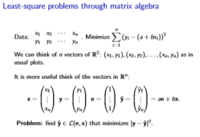
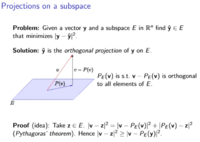
Hi everyone, in Statistics I'm studying linear regression and least square methods but I haven't great knowledge about linear algebra and vectors. If I understood correctly, my notes say that, to find the approximative regression line, I need to find the value of [MATH]\widehat{y}[/MATH] that minimizes [MATH]|y- \widehat{y}|^2[/MATH] and this value can be found in the orthogonal projection of y (the vector of real data y1...yn) in the vector space E, whose basis are e and x (the real fixed values of x: x1...xn).
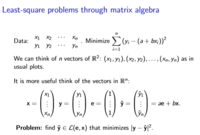
If I understood correctly, e is a unit column vector that's used to be multiplied by a scalar that has the value of the intercept, so that each yi will be defined taking account of the value of the intercept. But what's the usefulness of using a multiplied by a vector e=(1...1) instead of using directly a column vector a=(a...a)?
The formula is: [MATH]\widehat{y}=ae+bx[/MATH]Returning to the topic of the orthogonal projection, then my notes say that to find [MATH]\widehat{y}=ae+bx[/MATH] such that [MATH]y- \widehat{y}[/MATH] is orthogonal to all the elements of E is equal to find the value of [MATH]\widehat{y}[/MATH] and to to do that it's enough checking if [MATH]y- \widehat{y}[/MATH] is orthogonal to the elements of the basis: e and x, so that its product by e and x is 0.
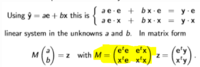
It can be expressed in the system:
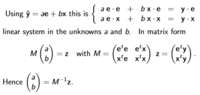
My question is, what's the meaning of M(a b)=z, and (a b) = M-1z? How they obtained it?
If I understood correctly, e is a unit column vector that's used to be multiplied by a scalar that has the value of the intercept, so that each yi will be defined taking account of the value of the intercept. But what's the usefulness of using a multiplied by a vector e=(1...1) instead of using directly a column vector a=(a...a)?
The formula is: [MATH]\widehat{y}=ae+bx[/MATH]Returning to the topic of the orthogonal projection, then my notes say that to find [MATH]\widehat{y}=ae+bx[/MATH] such that [MATH]y- \widehat{y}[/MATH] is orthogonal to all the elements of E is equal to find the value of [MATH]\widehat{y}[/MATH] and to to do that it's enough checking if [MATH]y- \widehat{y}[/MATH] is orthogonal to the elements of the basis: e and x, so that its product by e and x is 0.
It can be expressed in the system:
My question is, what's the meaning of M(a b)=z, and (a b) = M-1z? How they obtained it?