Anthonyk2013
Junior Member
- Joined
- Sep 15, 2013
- Messages
- 132

Stuck with what to do with ln2e^Teta (sorry on iPhone so no symbol for teta) sorry about image cant seem to turn it.

Please figure out how to post images that we can read. Thank you.Stuck with what to do with ln2e^Teta (sorry on iPhone so no symbol for teta) sorry about image cant seem to turn it.

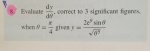
It would be really helpful if you would please start including the actual instructions for the exercises you post. It would save us having to guess, and often guessing incorrectly (and then providing off-topic "help").\(\displaystyle 8.\,y\, =\, \dfrac{2\, e^{\theta}\, \sin(\theta)}{\sqrt{\strut \theta^5\,}}\). . . . .\(\displaystyle \theta\, =\, \dfrac{\pi}{4}\)
From this line, I think that you're supposed to differentiate, and that the instructions specify that you're supposed to use logarithmic differentiation, such as is explained here. Did I guess correctly?\(\displaystyle \ln(y)\, =\, \ln\left\{\,\dfrac{2\, e^{\theta}\, \sin(\theta)}{\sqrt{\strut \theta^5\,}}\,\right\}\)
If I have correctly guessed what you're supposed to be doing, then I agree with your work up to this point.\(\displaystyle \ln(y)\, =\, \ln\left\{\, \dfrac{2\, e^{\theta}\, \sin(\theta)}{\theta^{\frac{5}{2}}}\, \right\} \)
\(\displaystyle \ln(y)\, =\, \ln(2)\, +\, \ln\left(e^{\theta}\right)\, +\, \ln\left(\sin(\theta)\right)\, -\, \ln\left(\theta^{\frac{5}{2}}\right)\)
By what rule did you eliminate the variable, \(\displaystyle \, \theta,\,\) from the second term?\(\displaystyle \ln(y)\, =\, \ln(2)\, +\, \ln\left(e\right)\, +\, \ln\left(\sin(\theta)\right)\, -\, \dfrac{5}{2}\, \ln\left(\theta \right)\)
You can simplify the third term (and the first one, too!). :wink:\(\displaystyle \dfrac{1}{y}\, \dfrac{dy}{d\theta}\, =\, 0\, +\, \dfrac{1}{\theta}\, +\, \dfrac{\cos(\theta)}{\sin(\theta)}\, +\, \dfrac{5}{2\, \theta}\)
Okay; so the original question was this:Apologies; my bad.
It would be really helpful if you would please start including the actual instructions for the exercises you post. It would save us having to guess, and often guessing incorrectly (and then providing off-topic "help").
From the inclusion of a value for the angle, I think you are supposed to evaluate something at some point. Did I guess correctly? What else are you supposed to be doing?
From this line, I think that you're supposed to differentiate, and that the instructions specify that you're supposed to use logarithmic differentiation, such as is explained here. Did I guess correctly?
If I have correctly guessed what you're supposed to be doing, then I agree with your work up to this point.
By what rule did you eliminate the variable, \(\displaystyle \, \theta,\,\) from the second term?
You can simplify the third term (and the first one, too!). :wink:
\(\displaystyle \ln(y)\, =\, \ln(2)\, +\, \ln\left(e^{\theta}\right)\, +\, \ln\left(\sin(\theta)\right)\, -\, \ln\left(\theta^{\frac{5}{2}}\right)\)
As stated by Stapel, your work is fine up through the above equation. It was wrong before after this, but your most recent post corrects your next step to:
\(\displaystyle ln\left(y\right)=ln\left(2\right)+\theta \cdot ln\left(e\right)+ln\left(sin\left(\theta \right)\right)-\frac{5}{2}ln\left(\theta \right)\)
After the corrections, this looks good to me. Then you differentiate:
\(\displaystyle \frac{1}{y}\frac{dy}{d\theta }=0+1+\frac{cos\left(\theta \right)}{sin\left(\theta \right)}-\frac{5}{2\theta }\)
This is fine too. However, you can still simplify the third term. Remember the basic six trig functions. Does cosine over sine mean anything to you? Then I think you can take it the rest of the way to the solution you were asked to find.
Almost. Sine over cosine is tangent, yes. But what about cosine over sine? Think about it this way: \(\displaystyle \frac{cos\left(\theta \right)}{sin\left(\theta \right)}=\frac{1}{\frac{sin\left(\theta \right)}{cos\left(\theta \right)}}=\frac{1}{tan\left(\theta \right)}=???\)
No, it's not the inverse, or arc-, tangent. Check your table of reciprocal equivalents.TanѲ -1
No, it's not the inverse, or arc-, tangent. Check your table of reciprocal equivalents.
correctcot ѳ