
You are using an out of date browser. It may not display this or other websites correctly.
You should upgrade or use an alternative browser.
You should upgrade or use an alternative browser.
Logarithm
- Thread starter Sultan101
- Start date

pka
Elite Member
- Joined
- Jan 29, 2005
- Messages
- 11,978
\(5\log(5)-2\log(5)=\log\left(5^5\right)-\log\left(5^2\right)=\log\left(\dfrac{5^5}{5^2}\right)=\log\left(5^3\right)=3\log(5)\)Is it possible that 5 log5-2 log5 =3log 5

Steven G
Elite Member
- Joined
- Dec 30, 2014
- Messages
- 14,605
You need to understand what a variable is and think about it at times like this.
I am sure that you would say that 5x-2x = 3x. Well what does that mean? It means that if you replace x with any number then that equation will hold true. For whatever reason x is being replaced with log5. So yes, 5log5 - 2 log5 = 3log5.
The only time this would not be true is if the value of x was not a real number like 12/0.
What if the problem had been 5*7 - 2*7. Wouldn't that be 3*7. You do not have to compute 5*7 and 3*7 to get 3*7 = 21.
Here is a question for you. So please respond back with your answer and steps in solving it. Compute 107*8 - 7*8 in your head. It is extremely simple if you think about it the right way. Go for it!
I am sure that you would say that 5x-2x = 3x. Well what does that mean? It means that if you replace x with any number then that equation will hold true. For whatever reason x is being replaced with log5. So yes, 5log5 - 2 log5 = 3log5.
The only time this would not be true is if the value of x was not a real number like 12/0.
What if the problem had been 5*7 - 2*7. Wouldn't that be 3*7. You do not have to compute 5*7 and 3*7 to get 3*7 = 21.
Here is a question for you. So please respond back with your answer and steps in solving it. Compute 107*8 - 7*8 in your head. It is extremely simple if you think about it the right way. Go for it!
Probably i couldn't make y'all understand what i was about to ask.Why would the difference result in anything else?

tkhunny
Elite Member
- Joined
- Apr 12, 2005
- Messages
- 11,322
Well, feel free to offer all necessary information up front. Don't be shy. The more of your own work you show, the better we can respond.Probably i couldn't make y'all understand what i was about to ask.
Well, feel free to offer all necessary information up front. Don't be shy. The more of your own work you show, the better
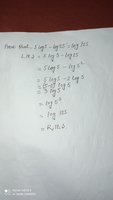
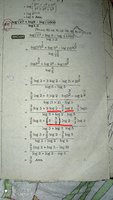
Please help First math is done by me
In the first math when i subtracted the 5log5-2log5 i solved for simple subtraction then with the help logarithmic rules i transferred the coefficient into power .Here i considered log5 as a variable and as we subtract 5a-2a=3a i followed the same rule.
Now my question is is it allowed to consider log as a variable and subtract as variables as there's no rule for subtraction in logarithmic rules
And if there is not then in my 2nd image(red marked) how did they solve it ?
In the first math when i subtracted the 5log5-2log5 i solved for simple subtraction then with the help logarithmic rules i transferred the coefficient into power .Here i considered log5 as a variable and as we subtract 5a-2a=3a i followed the same rule.
Now my question is is it allowed to consider log as a variable and subtract as variables as there's no rule for subtraction in logarithmic rules
And if there is not then in my 2nd image(red marked) how did they solve it ?

Harry_the_cat
Elite Member
- Joined
- Mar 16, 2016
- Messages
- 3,779
You're not considering log 5 as a variable. It's not a variable (it doesn't "vary"). You are applying the distributive law.
Is it any different to say 3 sinA + 5 sinA = 8 sin A OR \(\displaystyle 3\sqrt{2} + 5\sqrt{2} = 8\sqrt{2}\) ?
Is it any different to say 3 sinA + 5 sinA = 8 sin A OR \(\displaystyle 3\sqrt{2} + 5\sqrt{2} = 8\sqrt{2}\) ?
HallsofIvy
Elite Member
- Joined
- Jan 27, 2012
- Messages
- 7,760
The part marked in red is \(\displaystyle 3 log(2)- \frac{3}{2}log(2)\). As others have said, that has nothing to do with "properties of logarithms". For any quantities ax- bx= (a- b)x. \(\displaystyle 3x-\frac{3}{2}x= \left(3- \frac{3}{2}\right)x= \frac{3}{2}x\). If "x" happens to be log(2) then \(\displaystyle 3log(2)- \frac{3}{2}log(2)= \left(3- \frac{3}{2}\right)log(2)= \frac{3}{2}log(2)\).Please help First math is done by me
In the first math when i subtracted the 5log5-2log5 i solved for simple subtraction then with the help logarithmic rules i transferred the coefficient into power .Here i considered log5 as a variable and as we subtract 5a-2a=3a i followed the same rule.
Now my question is is it allowed to consider log as a variable and subtract as variables as there's no rule for subtraction in logarithmic rules[/tex]
?? There is log(a)- log(b)= log(a/b).
And if there is not then in my 2nd image(red marked) how did they solve it ?