
You are using an out of date browser. It may not display this or other websites correctly.
You should upgrade or use an alternative browser.
You should upgrade or use an alternative browser.
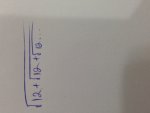
Math help please: sqrt{12 + sqrt{12 + sqrt{12 + sqrt{12 + ... }}}}
- Thread starter Fairydom
- Start date
D
Deleted member 4993
Guest
\(\displaystyle \displaystyle{\sqrt{12 + \sqrt{12 + \sqrt{12 + \sqrt{12 + \sqrt{12 + ....}}}}}}\)
Can someone help me please thank you in advance.
You do not have a question in your post!
What did you need to do?

Steven G
Elite Member
- Joined
- Dec 30, 2014
- Messages
- 14,605
Yes! I finally know an answer! First you read the problem, then you try to do it on your own and then and only then do you post the question EXACTLY AS IT APPEARS IN YOUR TEXTBOOK along with your attempt in working out the problem.You do not have a question in your post!
What did you need to do?
My best guess is that you're meant to be solving for the value of this radical, as the number of terms involved goes to infinity. There's two ways I'd approach this, one of which gets you the answer quickly, and the other is for "checking," to prove to yourself that the first solution did indeed work. We start with:
\(\displaystyle \displaystyle x=\sqrt{12 + \sqrt{12 + \sqrt{12 + \sqrt{12 + \sqrt{12 + ....}}}}}\)
Noting that there are an infinite number of terms, we see that the series is the same whether we start from the first term, the second term, the fifty-third term, etc. So let's substitute x for the entire series and rewrite the equation:
\(\displaystyle \displaystyle x= \sqrt{12 + x}\)
Now you should be able to solve it from there. The second method is more of an intuitive approach, using limits. Let's say the series was only two terms long:
\(\displaystyle \displaystyle x= \sqrt{12 + \sqrt{12}}\)
What value do you get? Now try it with five terms in the series. What value do you get then? With ten terms? Can you see the pattern, and extrapolate what would happen if there was an infinite number of terms?
\(\displaystyle \displaystyle x=\sqrt{12 + \sqrt{12 + \sqrt{12 + \sqrt{12 + \sqrt{12 + ....}}}}}\)
Noting that there are an infinite number of terms, we see that the series is the same whether we start from the first term, the second term, the fifty-third term, etc. So let's substitute x for the entire series and rewrite the equation:
\(\displaystyle \displaystyle x= \sqrt{12 + x}\)
Now you should be able to solve it from there. The second method is more of an intuitive approach, using limits. Let's say the series was only two terms long:
\(\displaystyle \displaystyle x= \sqrt{12 + \sqrt{12}}\)
What value do you get? Now try it with five terms in the series. What value do you get then? With ten terms? Can you see the pattern, and extrapolate what would happen if there was an infinite number of terms?
Bob Brown MSEE
Full Member
- Joined
- Oct 25, 2012
- Messages
- 597
hint
\(\displaystyle \displaystyle{\sqrt{12 + x}}\) = x\(\displaystyle \displaystyle{\sqrt{12 + \sqrt{12 + \sqrt{12 + \sqrt{12 + \sqrt{12 + ....}}}}}}\)
Can someone help me please thank you in advance.
Only if the sequence\(\displaystyle \displaystyle{\sqrt{12 + x}}\) = x
\(\displaystyle a_{n+1}\, =\, \sqrt{a_n\, +\, 12}\)
converges.
BTW, if that sequence converges, so does
\(\displaystyle a_{n+1}\, =\, -\sqrt{a_n\, +\, 12}\)
which is the 'phantom solution' introduced by the usual way of solving the resulting equation.