Mechanics particle projection

microl

New member
Joined
Feb 1, 2015
Messages
5
Two balls are projected from the same point with the same initial speed. The angles of projection are 2α and α to the horizontal respectively. Suppose that there is a delay of time T between the first ball being projected and the second ball being projected. Given that the balls collide find the speed of projection in terms of T and α.

Doing A level pure and further maths, finished M1 M2

The displacement of both particles from start point to collision will be the same right? So I do vertical and horizontal suvat for both particles, U is initial speed

vertical 2α (first particle)
u Usin2α
a -9.8
t t

vertical α (second particle)
u Usinα
a -9.8
t (t-T) time for first particle to collision minus the time delay
used s=ut+0.5at2 and equaled the 2 equations

tUsin2α -tUsinα -9.8tT = -TUsinα -4.9T2

horizontally I get t = (-Tcosα)/(cos2α -cosα) and sub into top equation

is this right? seems wrong to me as it becomes too complicated and nothing simplifies
 
That is very hard to read. I think you intended to write two columns but you did not say what the columns were and Internet readers, in general, do not "respect" spaces so it is difficult to say what you mean. Here is how I woul have done this.

Particle one is projected at angle 2a and speed, let's say, u. its initial vertical speed is u sin(2a) and its initial horizontal speed is u cos(2a). There is a constant vertical acceleration, due to gravity, of -g so the vertical speed, at time t, will be u cos(2a)- gt. There is no horizontal acceleration so the horizontal speed, at time t, will be the constant u sin(2a). Taking the initial height to be 0, the height at time t (integrating the vertical speed function or using "suvat") will be \(\displaystyle u cos(2a)t- (g/2)t^2\). The horizontal distance at time t will be \(\displaystyle u sin(2a) t\).

Particle two is projected at angle a and speed u. its initial vertical speed is u sin(a) and its initial horizontal speed is u cos(a). There is a constant vertical acceleration, due to gravity, of -g so the vertical speed, at time t, will be u cos(a)- gt. There is no horizontal acceleration so the horizontal speed, at time t, will be the constant u cos(a). Taking the initial height to be 0, the height at time t (integrating the vertical speed function or using "suvat") will be \(\displaystyle u cos(a)t- (g/2)t^2\). The horizontal distance at time t will be \(\displaystyle u sin(a) t\). However, ball two was projected a time interval, T, after ball one, so taking "t" to be 0 when the first ball, not the second ball, was projected, we need to replace "t" with "t- T". That is, the height of ball two, t seconds after ball one was projected, is \(\displaystyle u cos(a)(t- T)- (g/2)(t- T)^2\) and the horizontal distance is \(\displaystyle u sin(a)(t- T)\).

The two balls will "collide" if and only if both height and horizontal distance are the same for the same t. That is, we must have \(\displaystyle u cos(2a)t- (g/2)t^2= u cos(a)(t- T)- (g/2)(t- T)^2\) and \(\displaystyle u sin(2a) t= u sin(a)(t- T)\).
 
For particle one you say its initial vertical speed is usin(2a) but then say the height at time t is ucos(2a)t -(g/2)t2

The sin does not change to cos, using s=ut+(1/2)at2 you substitute the initial vertical velocity into the equation so vertical displacement for particle one =
usin(2a)t -(g/2)t2

I got the exact same 2 final equations as you did except with sin and cos switched around, then I simplified and got the 2 equations in my first post, my question is do I get the right answer if I substitute

t = (-Tcos(α))/(cos(2α) -cos(α))

into

tUsin(2α) -tUsin(α) -9.8tT = -TUsin(α) -4.9T2

Can someone try the original question and post what they get please?
 
I worked out the answer initial speed u = (4.9T(2cosα -1)(cosα+1))/(sinα) using gravity = 9.8
is this the right answer?
 
Last edited:
Burned out

Two balls are projected from the same point with the same initial speed. The angles of projection are 2α and α to the horizontal respectively. Suppose that there is a delay of time T between the first ball being projected and the second ball being projected. Given that the balls collide find the speed of projection in terms of T and α.

Doing A level pure and further maths, finished M1 M2

The displacement of both particles from start point to collision will be the same right? So I do vertical and horizontal suvat for both particles, U is initial speed

vertical 2α (first particle)
u Usin2α
a -9.8
t t

vertical α (second particle)
u Usinα
a -9.8
t (t-T) time for first particle to collision minus the time delay
used s=ut+0.5at2 and equaled the 2 equations

tUsin2α -tUsinα -9.8tT = -TUsinα -4.9T2

horizontally I get t = (-Tcosα)/(cos2α -cosα) and sub into top equation

is this right? seems wrong to me as it becomes too complicated and nothing simplifies

This is what I come up with. (Sorry I can't get the graphics just right.)

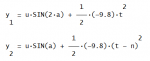
Elevation of ball 1 and 2.

MC-000.png

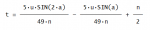
Equating the elevations and solving for the t, the time when they are equally elevated.

MC-001.jpg

Solving for t.

MC-002.png

Note that t is a function of initial velocity u, delay n and elevation angle a.

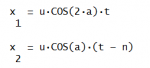
Distance of each ball from origin.

MC-003.png
To collide the balls must be not only at the same elevation at the same time but also at at the same x location, equating x1 and x2

MC-008.png

Solving for t.

MC-004.png.
Note that t computed this way is not dependent on u. (Sort of weird and worrisome.)

Since both components of the balls must be equal at the same time, equate the two different expressions for t.

MC-005.png

Solve for u.

MC-007.png

This gives the initial velocity as a function of angle and delay.

Whew! Maybe this makes sense or not, I have a headache. Good luck.
 
Top