
Minimum expectancy

Bootsif

New member
Joined
Mar 6, 2020
Messages
7
Hey, I got issues with this question. would like to get any ideas to solve it.

A random point (X,Y) has been chosen uniformly in the unit square. let S1, S2, S3, S4 be four triangles which have been created by connecting the random point to each edge of the square.
find Emim(S1,S2,S3,S4).
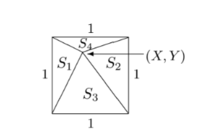
1583510640674.png
final answer : 1/12
 
is \(\displaystyle S_1\) the area of the triangle \(\displaystyle S_1\) ?
 
What does it mean to have the "minimum expectancy of (S1, S2, S3, S4)?" How is this defined or described?
 
Hey, I got issues with this question. would like to get any ideas to solve it.

A random point (X,Y) has been chosen uniformly in the unit square. let S1, S2, S3, S4 be four triangles which have been created by connecting the random point to each edge of the square.
find Emim(S1,S2,S3,S4).
View attachment 17038
final answer : 1/12
I am guessing that "Emim(S1,S2,S3,S4)" is meant to be something like E(min(S1,S2,S3,S4)), that is, the expected value of the minimum of the four areas. Please confirm that.

What I would do (and it does give the correct answer) is to divide the square into 4 or 8 equal regions meeting at the center, in each of which the smallest triangle will be obvious, and will have an easily calculated area, so that the integration over that region will be easy.

In order to give additional help, I'll need to know what you have learned about the subject. Hopefully this suggestion, or another, will give you enough of a start that you will have some work to show.
 
I am guessing that "Emim(S1,S2,S3,S4)" is meant to be something like E(min(S1,S2,S3,S4)), that is, the expected value of the minimum of the four areas. Please confirm that.

What I would do (and it does give the correct answer) is to divide the square into 4 or 8 equal regions meeting at the center, in each of which the smallest triangle will be obvious, and will have an easily calculated area, so that the integration over that region will be easy.

In order to give additional help, I'll need to know what you have learned about the subject. Hopefully this suggestion, or another, will give you enough of a start that you will have some work to show.

Yes, that is what it meant. sorry for not being clear.

What I was trying to do is to calculate each area of triangle with the parameters X,Y, for example S1 is equal to X/2 therefore S2 is equal to (1-X)/2 , S3 is equal to Y/2 therefore S4 is equal to (1-Y)/2.

Let min[X/2, (1-X)/2] to be marked as U.
Let min[Y/2, (1-Y)/2] to be marked as V.

X and Y are uniform in [0,1], therefore it can be inferred that U,V are uniform in [0,1/2].
Let W be the minimum of U and V.

I was trying to find the CDF of W in order to get the PDF of W and then to calculate EW = E(min(S1,S2,S3,S4)).

It is hard to tell what Ive learned in this subject.. any suggestion will help :)
 
I gave my suggestion: Rather than consider the entire square at once, restrict P(X, Y) to a region within which the smallest triangle is known, so you don't need to calculate a minimum. For example, if you draw in the diagonals of the square, whenever P is in the bottom triangle, S3 is the smallest. So find the expected value of S3 within this region.

Others may well have other ideas, which may work better for you depending on how you have done similar problems before. How do you find expected values from a CDF or PDF? Have you done other geometric probability problems?
 
Top