
Nearly Homogenous, now homogenous to seperable

willmoore21

Junior Member
Joined
Jan 26, 2012
Messages
75
Please read my last post, I am now stuck at the end, but have a look at the picture first, it will help to understand where I'm stuck at the next part.


Ok so I'm having problems with getting from homogeneous to seperable.

Here is my working, I am stuck at the end because usually the equation on top 1+2u-u^2 in this case cancels.
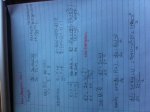
photo.jpg

Is this correct? it doesn't seem right but I can't see where I'm wrong.
 
Last edited:
Found out there I went wrong, on the last line I wrote 1 instead of 3. Then factorises to -(U-3)(U+1). Will post the full solution soon.
 
Found out there I went wrong, on the last line I wrote 1 instead of 3. Then factorises to -(U-3)(U+1). Will post the full solution soon.

Maybe this is it:

1/((U-3)(U+1))dU.

The only method I know how to do with would be partial fractions?

so I would have

1= A/(U-3) + B/(U+1)

1= AU +A + BU - 3B.

How am I supposed to figure out what A and B are?

Is it

0=A+B
1=A-3B

A=-B

B=-1/4
A=1/4

then

(1/4)1/(U-3)dU -(1/4)*1/(U+1)dU

to give

(log(U-3)-log(U+1))/4

That's what I have so far, still have to sub U back in. Will update.

So now I have to plug back in, U=Y/X

where Y=1-y
X= 2-x

So I have

[log(-5-y+3x)-log(3-y-x)]/4

Where do I go from here? How do I get y on it's own for the general solution?
 
Last edited:
I'm afraid I won't crank my head sideways to read your notebook paper, but you don't seem far from the end. How are you going to get rid of all those logs?
 
Top