
C calcnoob145 New member Joined Feb 24, 2013 Messages 13 Apr 21, 2013 #1 this is the problem i have dealing with the taylor series so the problem is the second differentation f"(x) where am i going wrong with my differentation and i alway end up with 1/1458 and not 1/5832 which is the correct answer
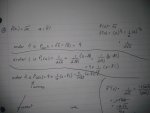
this is the problem i have dealing with the taylor series so the problem is the second differentation f"(x) where am i going wrong with my differentation and i alway end up with 1/1458 and not 1/5832 which is the correct answer
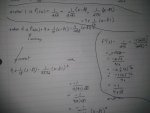
L lookagain Elite Member Joined Aug 22, 2010 Messages 3,250 Apr 21, 2013 #2 calcnoob145 said: this is the problem i have dealing with the taylor series View attachment 2772View attachment 2773View attachment 2774 so the problem is the second differentation f"(x) where am i going wrong with my differentation and i alway end up with 1/1458 and not 1/5832 which is the correct answer Click to expand... Your arithmetic is off: \(\displaystyle \dfrac{\bigg(\dfrac{-1}{2916}\bigg)}{2!} \ \ne \ \dfrac{-1}{1458}\) Instead, \(\displaystyle \ \ \dfrac{\bigg(\dfrac{-1}{2916}\bigg)}{2!} \ = \ \dfrac{-1}{2916} \ \div \ 2 \ = \ \dfrac{-1}{2916}\bigg(\dfrac{1}{2}\bigg) \ = \ \dfrac{-1}{5832}\) Last edited: Apr 21, 2013
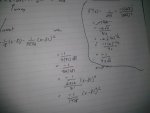
calcnoob145 said: this is the problem i have dealing with the taylor series View attachment 2772View attachment 2773View attachment 2774 so the problem is the second differentation f"(x) where am i going wrong with my differentation and i alway end up with 1/1458 and not 1/5832 which is the correct answer Click to expand... Your arithmetic is off: \(\displaystyle \dfrac{\bigg(\dfrac{-1}{2916}\bigg)}{2!} \ \ne \ \dfrac{-1}{1458}\) Instead, \(\displaystyle \ \ \dfrac{\bigg(\dfrac{-1}{2916}\bigg)}{2!} \ = \ \dfrac{-1}{2916} \ \div \ 2 \ = \ \dfrac{-1}{2916}\bigg(\dfrac{1}{2}\bigg) \ = \ \dfrac{-1}{5832}\)
C calcnoob145 New member Joined Feb 24, 2013 Messages 13 Apr 21, 2013 #3 oo wow its something simple that threw me off thanks got it