
need help on exponential function

tjharyono

New member
Joined
Oct 28, 2014
Messages
4
suppose that there is a graph, which has 2 points (0,1) and (4,5) .

For the exponential function given,

estimate the doubling time, and verify that it is constant.
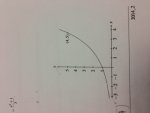
IMG_1594.JPG

so i tried to answer it, and i found the doubling time is equal to 1.722. however, the true answer is 1.9. can anyone help me to solve this question until we get 1.9?

my attempt :

P=Po e^kt
1=Po e^k(0)
Po = 1

5=e^k(4)
ln 5 = 4k
k = ln (5) / 4
k = 0.4024

2=e^0.4024t
ln 2 = 0.4024 t
t = ln (2) / 0.4024
t = 1.722
 
Last edited:
=

Since it talks about "doubling" time, why not use 2 as the base rather than e? Look for a function of the form \(\displaystyle P= C(2^{t/T})\). When t= 0, P= C= 1. When t= 4, \(\displaystyle P= 2^{4/T}= 5\). \(\displaystyle (4/T)ln(2)= ln(5)\). \(\displaystyle 4/T= \frac{ln(5)}{ln(2)}\), \(\displaystyle T/4= \frac{ln(2)}{ln(5)}\), \(\displaystyle T= 4 \frac{ln(2)}{ln(5)}= 1.722..\) just as you got. Why do you say "the true answer is 1.9"?
 
Since it talks about "doubling" time, why not use 2 as the base rather than e? Look for a function of the form \(\displaystyle P= C(2^{t/T})\). When t= 0, P= C= 1. When t= 4, \(\displaystyle P= 2^{4/T}= 5\). \(\displaystyle (4/T)ln(2)= ln(5)\). \(\displaystyle 4/T= \frac{ln(5)}{ln(2)}\), \(\displaystyle T/4= \frac{ln(2)}{ln(5)}\), \(\displaystyle T= 4 \frac{ln(2)}{ln(5)}= 1.722..\) just as you got. Why do you say "the true answer is 1.9"?

my tutor said that the answer is 1.9. Well, if that's the case, i'll talk to my tutor again. thanks for the help anyway :)
I use e function because my teacher only teach us with P=Poe^kt function, so i have no idea with the other formula. haha
 
my attempt :

P=Po e^kt \(\displaystyle \ \ \ \ \ \)At least put an asterisk right after Po for multiplication. You need grouping symbols
in the exponents in each step where there are products, because of the Order of Operations.


1=Po e^k(0)
Po = 1

5=e^k(4)
ln 5 = 4k
k = ln (5) / 4
k = 0.4024

2=e^0.4024t
ln 2 = 0.4024 t
t = ln (2) / 0.4024
t = 1.722 \(\displaystyle \ \ \ \ \) <------- This is not rounded correctly.

tjharyono, look at this:


P = Po*e^(kt)
1 = Po*e^[k(0)]
Po = 1

5 = e^[k(4)]
ln(5) = 4k
k = ln(5)/4
k ~ 0.4024

2 = e^(kt)
2 ~ e^(0.4024t)
ln(2) ~ 0.4024t
t ~ ln(2)/0.4024
t ~ 1.723
 
Top