
Mass Torque System
New member
- Joined
- Dec 11, 2025
- Messages
- 5
Hello everyone, and thanks in advance for taking the time to look at this. I’m working on a small mechanical project and I’m trying to understand the math behind what I’m measuring. I don’t want to post any links right away in case that violates forum rules, but if it’s allowed, I can share a short demo video and a roadmap that show the mechanism in action. Please let me know if that’s acceptable before I post anything external.
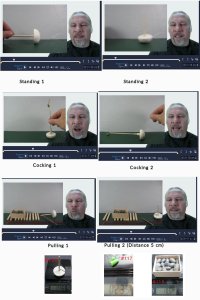
I’m experimenting with a lever‑based mechanism that stores gravitational energy and then releases it to pull a small sled. I’m still learning the proper terminology, so I’m hoping to get help understanding whether I’m interpreting the math correctly or missing something important.
Here are the measurements from one full input‑and‑output cycle:
Input (cocking the lever):
Force: 0.23 ounces
Distance: 14 centimeters
Time: 1.0 second
Work_in = 0.23 × 14 = 3.22 ounce‑centimeters
Power_in = 3.22 ÷ 1.0 = 3.22 ounce‑centimeters per second
Output (sled being pulled):
Force: 10.5 ounces
Distance: 5 centimeters
Time: 0.8 seconds
Work_out = 10.5 × 5 = 52.5 ounce‑centimeters
Power_out = 52.5 ÷ 0.8 = 65.63 ounce‑centimeters per second
Ratios:
Work_out / Work_in ≈ 16.3
Power_out / Power_in ≈ 20.4
Based on these numbers, the output work and output power appear much larger than the input values. I’m not claiming anything unusual — I’m just trying to understand how to interpret these results correctly. It may be that I’m not accounting for all the inputs, or that I’m misunderstanding how energy is stored and released inside the mechanism.
Any feedback, corrections, or guidance would be greatly appreciated. If it’s okay with the moderators, I can also share a short video and diagram to make the setup clearer.
Thanks again for your time.
I’m experimenting with a lever‑based mechanism that stores gravitational energy and then releases it to pull a small sled. I’m still learning the proper terminology, so I’m hoping to get help understanding whether I’m interpreting the math correctly or missing something important.
Here are the measurements from one full input‑and‑output cycle:
Input (cocking the lever):
Force: 0.23 ounces
Distance: 14 centimeters
Time: 1.0 second
Work_in = 0.23 × 14 = 3.22 ounce‑centimeters
Power_in = 3.22 ÷ 1.0 = 3.22 ounce‑centimeters per second
Output (sled being pulled):
Force: 10.5 ounces
Distance: 5 centimeters
Time: 0.8 seconds
Work_out = 10.5 × 5 = 52.5 ounce‑centimeters
Power_out = 52.5 ÷ 0.8 = 65.63 ounce‑centimeters per second
Ratios:
Work_out / Work_in ≈ 16.3
Power_out / Power_in ≈ 20.4
Based on these numbers, the output work and output power appear much larger than the input values. I’m not claiming anything unusual — I’m just trying to understand how to interpret these results correctly. It may be that I’m not accounting for all the inputs, or that I’m misunderstanding how energy is stored and released inside the mechanism.
Any feedback, corrections, or guidance would be greatly appreciated. If it’s okay with the moderators, I can also share a short video and diagram to make the setup clearer.
Thanks again for your time.

 ).
).


