Need help with exponential problem

lordbodom

New member
Joined
Jul 20, 2013
Messages
20
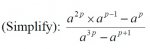
I have this problem that I have no idea how to solve. I know the basic exponential formula where a -x comes to be a 1/x. But I don't know how to solve situations like: a^x-1. Here is the problem I am trying to solve. (a^2p * a^p-1 - a^p)/(a^3p-a^p+1)
 
Last edited:
I know the basic exponential formula where a -x comes to be a 1/x.


You may know something, but the number -x never "comes to be" the number 1/x (we would need imaginary stuff, for that to happen). :cool:


Maybe you're thinking about the property that tells us how to interpret negative exponents:

a^(-1) = 1/a

Is this what you were trying to mention?


a^p * a^p-1 - a^p/a^3p-a^p+1

Your typing above is ambiguous because you did not use grouping symbols to indicate changes to the Order of Operations. When texting math expressions, you need to know about inserting parentheses around exponents that entail typing more than a single number AND about puting square brackets around both the numerator and the denominator of algebraic ratios.


Here is one possible interpertation of your typing:

[a^p*a^(p-1) - a^p]/[a^(3p) - a^(p+1)]

Is this what you meant? (If you don't understand the difference, let us know...)


Without any grouping symbols, your typing means this:

\(\displaystyle a^p \cdot a^p-1 - \dfrac{a^p}{a^3} p-a^p+1\)

I'm pretty certain that's not what you intend!


Finally, an expression without instructions does not make an exercise. Please remember to include the instructions. What did they ask you to do with the expression? Simplify it?

Here is a summary page of our posting guidelines. Cheers.
 
Last edited:
Thank you for the response. I am trying to simplify the problem. You are correct that i understand the property how to interpret negative exponentials. But i am not sure how to do an exponential that is not alone (x-1, p-a, etc). I tried looking online but couldnt find anything. I tried doing the problem breaking it up but have been unsuccessful so far.

The problem i need is.

a2p*ap-1-ap
a3p-ap+1

This is the format the problem is in.
 
Last edited:
Do the multiplication first:
[a^(3p-1) - a^p] / [a^(3p) - a^(p+1)]
Take out a^p:
{a^p[a^(2p-1) - 1]} / {a^p[a^(2p) - a]}
[a^(2p-1) - 1] / [a^(2p) - a]

Take over...2 more steps only...

A bit confused...If multiplied, wouldnt it equal to (a2p^2-1)-ap?

With the exponent rule, a2 * a3 = a5?
 
Thank you for the response. I am trying to simplify the problem. You are correct that i understand the property how to interpret negative exponentials. But i am not sure how to do an exponential that is not alone (x-1, p-a, etc). I tried looking online but couldnt find anything. I tried doing the problem breaking it up but have been unsuccessful so far.

The problem i need is.

a2p*ap-1-ap
a3p-ap+1

This is the format the problem is in.
At this site, you cannot EASILY show fractions in this form \(\displaystyle \dfrac{m + n}{p + q}\). If that is what you mean, type [m + n] / [p + q].

I very much doubt that what you show above is what anything looks like in your book.

MMM told you to use brackets to define expressions and / to indicate division. You can see what is in your book, but we cannot. You must make it clear.

Is this the problem?

\(\displaystyle Simplify\ \dfrac{a^{2p} * a^{p-1} - a^p}{a^{3p} - a^p}\)

If it is, show it as [a^(2p) * a^(p-1) - a^p] / [a^(3p) - a^p]. Otherwise, we are guessing about what the problem is.

Assuming THAT is the problem, the first step I would do is to factor

\(\displaystyle \dfrac{a^{2p} * a^{p-1} - a^p}{a^{3p} - a^p} = \dfrac{a^p(a^p * a^{(p-1)} - 1)}{a^p(a^{2p} - 1)}.\)

But this may be ALL wrong because you have not made clear what the problem is.

 
At this site, you cannot EASILY show fractions in this form \(\displaystyle \dfrac{m + n}{p + q}\). If that is what you mean, type [m + n] / [p + q].

I very much doubt that what you show above is what anything looks like in your book.

MMM told you to use brackets to define expressions and / to indicate division. You can see what is in your book, but we cannot. You must make it clear.

Is this the problem?

\(\displaystyle Simplify\ \dfrac{a^{2p} * a^{p-1} - a^p}{a^{3p} - a^p}\)

If it is, show it as [a^(2p) * a^(p-1) - a^p] / [a^(3p) - a^p]. Otherwise, we are guessing about what the problem is.

Assuming THAT is the problem, the first step I would do is to factor

\(\displaystyle \dfrac{a^{2p} * a^{p-1} - a^p}{a^{3p} - a^p} = \dfrac{a^p(a^p * a^{(p-1)} - 1)}{a^p(a^{2p} - 1)}.\)

But this may be ALL wrong because you have not made clear what the problem is.

Sorry for the confusion regarding the problem. The problem exactly is to simplify :

a2p*ap-1-ap
a3p-ap+1
 
A bit confused...If multiplied, wouldnt it equal to (a2p^2-1)-ap?

With the exponent rule, a2 * a3 = a5?

That rule tells us to add exponents, yes? The 5 comes from adding the exponents 2 and 3.

So, you need to add the exponents 2p and p-1.

2p + p - 1 = 3p - 1

You got confused and multiplied 2p*p instead of adding 2p+p. It happens... :)
 
a2p*ap-1-ap
a3p-ap+1
I asked you, politely I thought, not to use this type of formatting. I have no idea what it means. There is a way to express things in plain text, a way that has now been explained to you twice. There is also a way to express things in more traditional form, but it is not super-easy to learn.
 
I asked you, politely I thought, not to use this type of formatting. I have no idea what it means. There is a way to express things in plain text, a way that has now been explained to you twice. There is also a way to express things in more traditional form, but it is not super-easy to learn.

And i told you more than once im sorry and im new at this type of format. Just want some math help thats all.

let me see if i can do this again. sorry in advance if this isnt the format thats acceptable here.

[a2p*ap-1-ap]/[a3p-ap+1]

Im using this with the toolbar tool that are available. Here is the problem without using the toolbar tool:

[a^(2p) * a^(p-1)-a^(p)]/[a^(3p)-a^(p+1)]

Hope i got it right this time.
 
Last edited:
And i told you more than once im sorry and im new at this type of format. Just want some math help thats all.

let me see if i can do this again. sorry in advance if this isnt the format thats acceptable here.

[a2p*ap-1-ap]/[a3p-ap+1]

Im using this with the toolbar tool that are available. Here is the problem without using the toolbar tool:

[(a^2p) * (a^p-1)-(a^p)]/[(a^3p)-a^p+1)]

Hope i got it right this time.

Is your problem:

\(\displaystyle \displaystyle \frac {a^{2p} \ * \ a^p \ - 1 \ - \ a^p}{a^{3p} \ - \ a^p \ + \ 1}\) which is equivalent to [(a^2p) * (a^p-1)-(a^p)]/[(a^3p)-a^p+1)]

or

\(\displaystyle \displaystyle \frac {a^{2p} \ * \ a^{p \ - 1} \ - \ a^p}{a^{3p} \ - \ a^{p \ + \ 1}}\) which is equivalent to [a2p*ap-1-ap]/[a3p-ap+1]
 
Last edited by a moderator:
And i told you more than once im sorry and im new at this type of format. Just want some math help thats all.

We are perfectly willing to give help. We just need students to make their problems clear. Apology accepted.

let me see if i can do this again. sorry in advance if this isnt the format thats acceptable here.

[a2p*ap-1-ap]/[a3p-ap+1]

Im using this with the toolbar tool that are available. I appreciate the effort displayed in using the tool bar, but it may make explaining your problems harder and more prone to error.

Here is the problem without using the toolbar tool:

[a^(2p) * a^(p-1)-a^(p)]/[a^(3p)-a^(p+1)] Excellent. Thank you.

Hope i got it right this time.

[a^(2p) * a^(p-1)-a^(p)]/[a^(3p)-a^(p+1)] = \(\displaystyle \dfrac{a^{2p} * a^{(p - 1)} - a^p}{a^{3p} - a^{(p + 1)}}.\) First I would factor

\(\displaystyle \dfrac{a^{2p} * a^{(p - 1)} - a^p}{a^{3p} - a^{(p + 1)}} = \dfrac{a^p(a^p * a^{(p-1)} - 1)}{a^{(p + 1)}(a^{(2p - 1)} - 1)}.\) Do you follow that? If not we can take it in steps.
 
[a^(2p) * a^(p-1)-a^(p)]/[a^(3p)-a^(p+1)] = \(\displaystyle \dfrac{a^{2p} * a^{(p - 1)} - a^p}{a^{3p} - a^{(p + 1)}}.\) First I would factor

\(\displaystyle \dfrac{a^{2p} * a^{(p - 1)} - a^p}{a^{3p} - a^{(p + 1)}} = \dfrac{a^p(a^p * a^{(p-1)} - 1)}{a^{(p + 1)}(a^{(2p - 1)} - 1)}.\) Do you follow that? If not we can take it in steps.

I follow the top factorization, but not the bottom. How can we factorize with [a^(p+1)] if there is no p+1 with [a^(3p)]?
 
I follow the top factorization, but not the bottom. How can we factorize with [a^(p+1)] if there is no p+1 with [a^(3p)]?
\(\displaystyle a * a^{(2p - 1)} = a^{(2p - 1 + 1)} = a^{2p}.\) Right? \(\displaystyle a * a^5 = a^6.\) and 5 = 2 * 3 - 1.

So \(\displaystyle a^{3p} = a^p * a^{2p} = a^p * a^1 * a^{(2p-1)} = a^{(p+1)} * a^{(2p -1)}.\)
 
Last edited:
\(\displaystyle a * a^{(2p - 1)} = a^{(2p - 1 + 1)} = a^{2p}.\) Right? \(\displaystyle a * a^5 = a^6.\) and 5 = 2 * 3 - 1.

So \(\displaystyle a^{3p} = a^p * a^{2p} = a^p * a^1 * a^{(2p-1)} = a^{(p+1)} * a^{(2p -1)}.\)

I think i understand. Thanks.
 
I think i understand. Thanks.
A LAW of exponents is

\(\displaystyle a^i * a^j = a^{(i + j)}.\)

\(\displaystyle So\ a^{3p} = a^{(p+1)} * a^{(2p - 1)}\ because\ 3p = (p + 1) + (2p - 1).\)

OK What next on your problem?
 
I'll REPEAT: do the multiplication first;
you didn't seem to understand what I meant;
I simply mean a^(2p) times a^(p-1) : that's the ONLY multiplication showm in your expression!

And a^(2p) times a^(p-1) = a^(2p + p-1) = a^(3p-1)

That'll simplify your expression a bit : got that?

THank you. Heres what i got so far by first mulitplying then factoring:

[a^(3p-1)-a^(p)]/[a^(3p)-a^(p+1)]

then factorizing:

[a^(p){a^(2p-1)-1}]/[a^(p){a^(2p)-a}]

Not 100% sure about the bottom factor, would factoring a^(p) give a (-a) with [-a^(p+1)]?
 
THank you. Heres what i got so far by first mulitplying then factoring:

[a^(3p-1)-a^(p)]/[a^(3p)-a^(p+1)]

then factorizing:

[a^(p){a^(2p-1)-1}]/[a^(p){a^(2p)-a}] OK but you can factor another a out of the denominator as I explained before.

Not 100% sure about the bottom factor, would factoring a^(p) give a (-a) with [-a^(p+1)]?
Please review my previous posts on factoring and the laws of exponents.

\(\displaystyle \dfrac{a^p(a^{(2p - 1)} - 1)}{a^p(a^{2p} - a)} = \dfrac{a^p(a^{(2p - 1)} - 1)}{a^p * a * (a^{(2p-1)} - 1)} = \dfrac{a^p}{a^{(p+1)}} = \dfrac{1}{a}.\)

LAWS OF EXPONENTS

\(\displaystyle a^i * a^k \equiv a^{(i + k)}.\) This works whatever the sign of i or k.

\(\displaystyle \dfrac{a^i}{a^k} \equiv a^{(i - k)}.\) This works whatever the sign of i or k.

\(\displaystyle \left(a^i\right)^k \equiv a^{ik}.\) This works whatever the sign of i or k.

\(\displaystyle a^{-i} \equiv \dfrac{1}{a^i}.\) This works whatever the sign of i.

In particular \(\displaystyle (a^{3p} - a^{(p+1)}) = a^{(p+1)}(a^{(2p-1)} - 1)\ because\ a^{3p} = a^{\{(p + 1) + (2p - 1)\}} = a^{(p + 1)} * a^{(2p - 1)}.\)

You are letting minus signs in the exponents throw you for a loop. 3p = p + 2p + 1 - 1 = (p + 1) + (2p - 1). Now apply the first law of exponents above.
 
Last edited:
Top