Need help with probability math problem

Clark Jones

New member
Joined
Apr 30, 2021
Messages
3
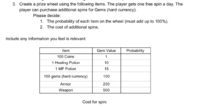
I'm having trouble having my percentages add up to 100%. There must be a way to do this perfectly but I cant seem to figure it out
Here's the math problem:

Screen Shot 2021-04-30 at 7.09.49 PM.png
 
Please post your work. What is the source of your problem, considering it's you who is deciding what the percentages are?
 
I think my question is, is there a mathematical solution to this probability problem? Gem valuue over total gems x100? I know i Can just pick any percentages I want and add it up to 100% that's not why I posted this.
 
Is the wheel supposed to make money if someone purchases more than one spin?
 
What exactly do you want as a percentage that adds to 100%?

If it is simply the "items", as you say, then, since there are 6 items, each one has percentage 100/6= 16 and 2/3 percent.

But if it is the "values" that you want percentages for, then there is a total "value" of 1+ 10+ 15+ 100+ 200+ 250+ 500= 1076. The percentage of total value for each item is its "value" divided by 1076.
 
Well, I'm not sure, but it seems as if you get to choose the probability of each item being landed on in the prize wheel. Simply assign a probability and off you go, all the while making sure that the total probability doesn't exceed 1.

If your goal is to break even, then you're going to have to create the spin wheel such that the Gem Cost Expected Value (the mean gems lost) will be equal to the cost per spin. Anything less and you will lose money. Anything more and you will earn money.

There's no shortage of ways to answer this question. Try this method, for example:

You have 6 Items that are going to be on your prize wheel. The area of your prize wheel must contain all 6 items. Let's construct a prize wheel such that the Gem Cost per unit Arc Length is equal (probabilistically) at all points along the circle:

The total arc length of a circle is 2*pi*r.

The Gem cost per arc length is (Gem Cost) / (r*theta). This value needs to be the same for all arc lengths such that the sum of all thetas is equal to 2*pi radians.

I don't know if I lost you in all of my words, but yeah... Good luck.
 
Top
