
'Nice' cubic polynomials

Bods835

New member
Joined
Apr 5, 2016
Messages
1
Hi guys.

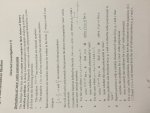
I have a maths investigation that I'm having some trouble with. I have been away sick for a few days and have missed discussions in class about it. Particularly, I'm having issues with question C in the image I've attached. I've had no issues so far with A and B, but I would be very appreciative if someone could read through the image and help me out with question C. Cheers.
 

Attachments

  • image.jpg
    image.jpg
    501.4 KB · Views: 6
I have a maths investigation that I'm having some trouble with. I have been away sick for a few days and have missed discussions in class about it. Particularly, I'm having issues with question C in the image I've attached.
I've tried downloading your image, rotating it, and enlarging it, but I still can't read many portions of the text contained in it.

Please reply with the text of part (C). When you reply, please include a clear listing of your thoughts and efforts so far (including necessary results, if any, from parts (A) and (B) of the project). If you are needing lesson instruction over the material taught during the days you missed, please state the specific topics you're needing. Thank you! ;)
 
I believe the meaning of the word "nice" in this context is more in line with Bob's second link. As stated in the image posted by the student:

...teachers frequently want to use a cubic polynomial [...] that has the following properties:
  • The equation f(x) = 0 has solutions that are rational numbers
  • The equation f'(x) = 0 has solutions that are rational numbers

In other words, a "nice" cubic polynomial is one with rational roots and rational critical points. As for part c of the problem, it states:

Consider the function [...] \(\displaystyle f(x)=x(x-pr)(x-qs)\), where p, q, r, and s are non-zero rational numbers.

c) What conditions can be placed on p, q, r, and s so that the cubic polynomial is "nice?"

Now, this problem is quite kind to you because the polynomial comes pre-factored for you. If you take the polynomial and set it to equal to 0, what can you say about its roots? Hint: Do you recall the zero-product principle? And the second criteria involves taking the derivative and setting that equal to zero. What is the derivative? What do you then notice about any critical points? What do these things imply about possible values of p, q, r, and s?
 
Top