
You are using an out of date browser. It may not display this or other websites correctly.
You should upgrade or use an alternative browser.
You should upgrade or use an alternative browser.
nth derivative of algebraic function
- Thread starter anil86
- Start date
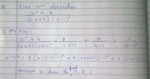
View attachment 3464
Please view attachment!!!
you sort of have the right idea so far
one mistake you've made is that
\(\displaystyle
\frac{A}{2 x+3}+\frac{B}{x-1}+\frac{C}{(x-1)^2}=\frac{A (x-1)^2+B (2 x+3)(x-1)+C (2 x+3)}{(2 x+3) (x-1)^2}
\)
which isn't quite what you've written. Once you've corrected this just expand everything and solve for A, B, C.
you sort of have the right idea so far
one mistake you've made is that
\(\displaystyle
\frac{A}{2 x+3}+\frac{B}{x-1}+\frac{C}{(x-1)^2}=\frac{A (x-1)^2+B (2 x+3)(x-1)+C (2 x+3)}{(2 x+3) (x-1)^2}
\)
which isn't quite what you've written. Once you've corrected this just expand everything and solve for A, B, C.
I got A = 1 & C = 1
How to get B?
Note: I don't know how to do partial fraction when there is (a -b)^2 in denominator. I can solve if it only has (a - b) in denominator.
Last edited:
I got A = 1 & C = 5
How to get B?
Note: I don't know how to do partial fraction when there is (a -b)^2 in denominator. I can solve if it only has (a - b) in denominator.
You should review your partial fractions then.
The equation you want to solve is
\(\displaystyle \frac{x^2+4}{(2 x+3) (x-1)^2}=\frac{A}{2 x+3}+\frac{B}{x-1}+\frac{C}{(x-1)^2}\)
You should know how to solve this sort of equation. Just multiply by factors as necessary to get both sides over the same denominator, collect the powers of x, and solve the 3 equations.
Your answer above is incorrect.