
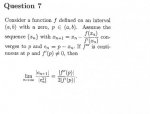
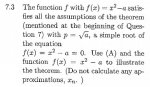
At first glance I was thinking the convergence theorem of the Newton Raphson method for a simple root which looks like this.
And taking a look inside the proof:
With these condition being true:
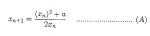
So now applying this to (A)...
Now simply proving that g'(x) evaluated at p equates to 0
Thus illustrating the theorem.
This is all I have so far. I don't know if this is 100% correct.
If someone could verify this for me or tell me if I left out something I would appreciate it.