Hi,
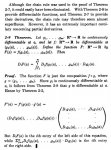
this question is about something in the book Spivak: "Calculus on Manifolds" (1995) which I don't quite understand. It is theorem 2-9 on page 32:
Let \(\displaystyle g_1, \dots, g_m : \mathbb{R}^n\rightarrow\mathbb{R}\) be continuously differentiable at \(\displaystyle a\), and let \(\displaystyle f: \mathbb{R}^m\rightarrow\mathbb{R}\) be differentiable at \(\displaystyle (g_1(a), \dots, g_m(a))\). Define the function \(\displaystyle F: \mathbb{R}^n\rightarrow \mathbb{R}\) by \(\displaystyle F(x)=f(g_1(x), \dots, g_m(x))\). Then
\(\displaystyle D_i F(a) = \sum_{j=1}^m D_j f(g_1(a), \dots, g_m(a))\cdot D_i g_j(a)\)
Why is it required that the functions \(\displaystyle g_1, \dots, g_m\) are continuously differentiable?
He already proved the general multidimensional chain rule \(\displaystyle D (g\circ f)(a) = Dg(f(a))\circ Df(a)\) only requiring \(\displaystyle f\) and \(\displaystyle g\) to be differentiable functions.
In the proof of theorem 2-9 he seems to need it to show that the function \(\displaystyle g = (g_1, \dots, g_m)\) is differentiable... but isn't "component functions differentiable \(\displaystyle \Rightarrow\) function differentiable" already a basic result that follows from the general chain rule, so that \(\displaystyle f, \,g\) don't have to be continuously differentiable, just differentiable?
Thanks in advance for any help! (maybe I'm lucky and somebody worked with this book...)
this question is about something in the book Spivak: "Calculus on Manifolds" (1995) which I don't quite understand. It is theorem 2-9 on page 32:
Let \(\displaystyle g_1, \dots, g_m : \mathbb{R}^n\rightarrow\mathbb{R}\) be continuously differentiable at \(\displaystyle a\), and let \(\displaystyle f: \mathbb{R}^m\rightarrow\mathbb{R}\) be differentiable at \(\displaystyle (g_1(a), \dots, g_m(a))\). Define the function \(\displaystyle F: \mathbb{R}^n\rightarrow \mathbb{R}\) by \(\displaystyle F(x)=f(g_1(x), \dots, g_m(x))\). Then
\(\displaystyle D_i F(a) = \sum_{j=1}^m D_j f(g_1(a), \dots, g_m(a))\cdot D_i g_j(a)\)
Why is it required that the functions \(\displaystyle g_1, \dots, g_m\) are continuously differentiable?
He already proved the general multidimensional chain rule \(\displaystyle D (g\circ f)(a) = Dg(f(a))\circ Df(a)\) only requiring \(\displaystyle f\) and \(\displaystyle g\) to be differentiable functions.
In the proof of theorem 2-9 he seems to need it to show that the function \(\displaystyle g = (g_1, \dots, g_m)\) is differentiable... but isn't "component functions differentiable \(\displaystyle \Rightarrow\) function differentiable" already a basic result that follows from the general chain rule, so that \(\displaystyle f, \,g\) don't have to be continuously differentiable, just differentiable?
Thanks in advance for any help! (maybe I'm lucky and somebody worked with this book...)