Partial sums

renegade05

Full Member
Joined
Sep 10, 2010
Messages
260
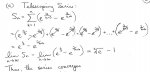
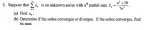
My question is referring to part (b) of this question.

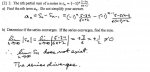
Does my professor have this wrong? I was under the impression that the limit of the nth partial sum as n goes to infinity is what the sum converges to.

Is the answer not: it converges to 1/2 ?

I understand if An does not equal zero the series will diverge, but we are talking about Sn here. :shock:

Can someone please clarify ? THANKS!
 

Attachments

  • Capture.JPG
    Capture.JPG
    43.8 KB · Views: 57
You seem to be flopping about a bit. Are you looking for Sn or |Sn|? Sn does NOT converge.

There is a reason why you were told NOT to simplfy your answer for the nth term. You would not have tested Sn if you knew the terms failed to disappear.
 
According to:


http://www.brookscole.com/math_d/templa ... index.html

your lines should be:

\(\displaystyle If \lim_{n \to \infty} a_n \ does \ not \ exist, \ or \ if \lim_{n \to \infty}a_n \ \ne \ 0, \ then \ \sum_{n = 1}^{\infty} a_n \ diverges.\)


\(\displaystyle \lim_{n \to \infty}a_n \ =\)

\(\displaystyle \ \lim_{n \to \infty}({S_n - S_{n - 1}) \ =\)

\(\displaystyle \ \lim_{n \to \infty}S_n \ - \ \lim_{n \to \infty}S_{n - 1}\)


If n is even, then the difference of the limits is -1, but if n is odd,

then the difference of the limits is 1.


\(\displaystyle Because \ of \ the \ above \ information \ in \ the \ prior\ sentence,\)

\(\displaystyle \ \lim_{n \to \infty} \ does \ not \ exist.\)

\(\displaystyle So \ then \ the \ series \ diverges.\)
 
Thank you guys. I got it now. I was confusing two different things.

So many rules and tests when it comes to sequences and series, sometimes they all melt together.
 
Ok you know what, actually i dont understand.

How come when you take the limit of this Sn my teacher says it converges even though it does not equal zero.

What is the difference between these two questions?
 

Attachments

  • Capture2.JPG
    Capture2.JPG
    62.5 KB · Views: 28
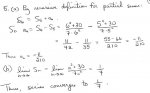
Here is another example from my teacher:

[attachment=1:3rsrz4w8]Capture3.JPG[/attachment:3rsrz4w8]
[attachment=0:3rsrz4w8]Capture4.JPG[/attachment:3rsrz4w8]

See i don't understand why this Sn converges to 1/7 but the other one diverges because it equals 1/2 ?

Where does my confusion lye?
 

Attachments

  • Capture3.JPG
    Capture3.JPG
    24 KB · Views: 27
  • Capture4.JPG
    Capture4.JPG
    37.8 KB · Views: 27
renegade05 said:
Here is another example from my teacher:

[attachment=1:2elbaf9w]Capture3.JPG[/attachment:2elbaf9w]
[attachment=0:2elbaf9w]Capture4.JPG[/attachment:2elbaf9w]

See i don't understand why this Sn converges to 1/7 but the other one diverges because it equals 1/2 ?

Where does my confusion lye?

renegade, let me choose to look at the immediate problem above.

Look back at my post.

No, you are *not* taking the limit of \(\displaystyle S_n \ as \ n \to \infty.\)

You are taking the limit of \(\displaystyle a_n \ as \ n \to \ \infty.\)

And recall \(\displaystyle a_n \ = \ S_n \ - \ S_{n-1}\)

\(\displaystyle Then \ \lim a_n \ as \ n \to \ \infty\ = \ \frac{1}{7} \ - \ \frac{1}{7} \ = \ 0\)


A) What does this result mean about the convergence or divergence of the series?

B) If it means the series is convergent, can you work out the value of the limit?
 
Answering your (b) question. Yes, the series converges to 1/7.

I think i might understand now... its slowly making some sense.
 
Top