What are you having trouble with? Here are some hints that may help:
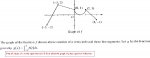
If g(t) represents the integral of f(t) for that particular interval, you can think of f(t) as the derivative of g(t) and f'(t) = g"(t).
What conditions must you have in order for a point on g to be an inflection point?
Now, WHERE would you suspect to find an inflection point given f(t) = g'(t) (for that particular interval)?
im on math team and it was a question on a team test of ours. i dont have a lot of calculus under my belt. i know derivates. but what is point of inflection
How does your book (or this text) define inflection points? Must the second derivative equal zero, or can it be undefined? Or should you only look at points where the second derivative changes sign?
So where is g"(t) = f'(t) = 0? But be careful when using this, just knowing that f"(t) = 0 is not sufficient in determining whether or not it actually is an inflection point (ex. y = x[sup:147sei12]4[/sup:147sei12] it is concave up everywhere)
This site uses cookies to help personalise content, tailor your experience and to keep you logged in if you register.
By continuing to use this site, you are consenting to our use of cookies.
