Probability Mass Function

peterfede

New member
Joined
Oct 2, 2020
Messages
9
Hi everyone,
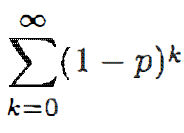
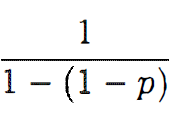
can anyone tell me how to get 1, STEP BY STEP, from the expression below? It is the proof of the geometric distribution, but I don't understand what's happened in the third step ( k below the summation has chaged from 1 to 0, and (1-p) is just rised to k), and in the four step as well.

1601671490507.png
The same is for the following expression:

1601671789749.png
Thanks so much
 
Hi everyone,
can anyone tell me how to get 1, STEP BY STEP, from the expression below? It is the proof of the geometric distribution, but I don't understand what's happened in the third step ( k below the summation has chaged from 1 to 0, and (1-p) is just rised to k), and in the four step as well.
View attachment 22012
The same is for the following expression:
View attachment 22013
Thanks so much
Suppose we substitute:

m = k-1, then when k =1 we would have m = 0

\(\displaystyle \sum_{k=1}^{\infty}(1-p)^{k-1} \ = \ \sum_{m=0}^{\infty}(1-p)^m\)

It should be realized that the above is a geometric series with a well known expression for summation.
 
Hi everyone,
can anyone tell me how to get 1, STEP BY STEP, from the expression below? It is the proof of the geometric distribution, but I don't understand what's happened in the third step ( k below the summation has changed from 1 to 0, and (1-p) is just rised to k), and in the four step as well.
View attachment 22012
The same is for the following expression:
View attachment 22013
Thanks so much
The second is the Maclaurin series for e^x: https://en.wikipedia.org/wiki/Taylor_series#Exponential_function Your are expected just to recognize it, I imagine.
 
Thanks both of you for the response.
For the first image, I knew it was a geometrical series, but I can't demonstrate the formula (I have demostrate the PMF of the geometrical distribution).
So, when the power m goes to infinite, the ending result should be 0, but in this case is not.
For the second image is okay.
 
Thanks both of you for the response.
For the first image, I knew it was a geometrical series, but I can't demonstrate the formula (I have demostrate the PMF of the geometrical distribution).
So, when the power m goes to infinite, the ending result should be 0, but in this case is not.
For the second image is okay.
Why do you think so? Can you demonstrate your conjecture?

Choose an arbitrary value of 'p' (say p = 0.25).

How much is (1-p)? = 0.75

Now write the sequence:

1, 3/4, 9/16, 27/64, 81/256,..... gradually going to 0.
 
Absolutely agree with you, but this sommation 1601723633278.png seems to be equal to 1601723670850.png. Why?
It is for sure a stupid question but I am a bit lost.
 
1/(1-x). So this means that we have the limit of k that goes to infinite of : [1-(1-p)^k]/[1-(1-p)]. So, the power is zero and the result is 1/[1-(1-p)].
Now I find myself.
 
Top