

KrabLord
New member
- Joined
- Jul 27, 2019
- Messages
- 38
This is from Mathematics for Biological Scientists.
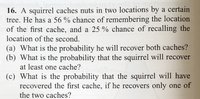
“16. A squirrel caches nuts by a certain tree. He has a 56% chance of remembering the location by the first tree, and a 25% chance of remembering the location by the second.
(c) What is the probability that the squirrel will have recovered the first cache, if he recovers only one of the two caches?”
My approach has been, P(Cache1 success given At least one cache) = (1 • 0.56)/0.67 = 0.8358
(Where 0.67 is the computed probability of the squirrel finding at least one cache, found by taking the converse probability of finding none; and where 1 is the probability of finding at least one cache given cache1 was found).
I feel this answer, ~84%, is correct. However, the book says the answer is 79.2%. How is that possible?
“16. A squirrel caches nuts by a certain tree. He has a 56% chance of remembering the location by the first tree, and a 25% chance of remembering the location by the second.
(c) What is the probability that the squirrel will have recovered the first cache, if he recovers only one of the two caches?”
My approach has been, P(Cache1 success given At least one cache) = (1 • 0.56)/0.67 = 0.8358
(Where 0.67 is the computed probability of the squirrel finding at least one cache, found by taking the converse probability of finding none; and where 1 is the probability of finding at least one cache given cache1 was found).
I feel this answer, ~84%, is correct. However, the book says the answer is 79.2%. How is that possible?
