
You are using an out of date browser. It may not display this or other websites correctly.
You should upgrade or use an alternative browser.
You should upgrade or use an alternative browser.
Probability question 4
- Thread starter galbax02
- Start date
D
Deleted member 4993
Guest
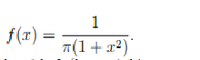
Since you cannot even begin to solve these - we will start with definitions:Consider the density function
View attachment 24710
Show how to generate a random variable with this density function.
HINT: The generated random variable follows a Cauchy distribution
Please provide definitions (as related to this problem) of:
- density function
- random variable
- Cauchy distribution
This is a useful enough problem for others to provide a solution w/o the student making any effort at all.
They get one freebie.
In general if you want to generate a random variable with a CDF [MATH]F(x)[/MATH]You generate a uniform random variate [MATH]u[/MATH] in [0,1] and let
[MATH]X = F^{-1}(u)[/MATH]
But that only works if [MATH]F[/MATH] has an inverse. If it doesn't you have to get clever.
In this case [MATH]F[/MATH] does not have an inverse, but it's domain can be partitioned into two subsets each on which it does.
Obviously in this case the two sets are [MATH](-\infty,0), [0, \infty)[/MATH].
So what we do is generate a random variable on [MATH][0, \infty)[/MATH] and then flip a coin for the sign.
[MATH]F(x) = \int f(x)~dx = \dfrac{\arctan(x)}{\pi}[/MATH] but we're only considering half the domain so we have to add a factor of 2
of course we can only be so casual about all this because the distribution is symmetric about 0.
[MATH]F(x) = \dfrac{2}{\pi} \arctan(x),~x \in \mathbb{R}^+\cup \{0\}[/MATH]
[MATH]F^{-1}(x) = \tan\left(\dfrac{\pi x}{2}\right),~x \in \mathbb{R}^+\cup \{0\}[/MATH]
So....
Fire up your trusty rng that generates uniform real numbers in the range of [MATH][0,1][/MATH]and generate [MATH]u_1,~u_2[/MATH]
[MATH]X = (2[u_1]-1) \cdot \tan\left(\dfrac{\pi u_2}{2}\right)[/MATH]
where
[MATH][x] = \begin{cases}1 &x \geq \dfrac 1 2\\0 &x < \dfrac 1 2\end{cases}[/MATH]
They get one freebie.
In general if you want to generate a random variable with a CDF [MATH]F(x)[/MATH]You generate a uniform random variate [MATH]u[/MATH] in [0,1] and let
[MATH]X = F^{-1}(u)[/MATH]
But that only works if [MATH]F[/MATH] has an inverse. If it doesn't you have to get clever.
In this case [MATH]F[/MATH] does not have an inverse, but it's domain can be partitioned into two subsets each on which it does.
Obviously in this case the two sets are [MATH](-\infty,0), [0, \infty)[/MATH].
So what we do is generate a random variable on [MATH][0, \infty)[/MATH] and then flip a coin for the sign.
[MATH]F(x) = \int f(x)~dx = \dfrac{\arctan(x)}{\pi}[/MATH] but we're only considering half the domain so we have to add a factor of 2
of course we can only be so casual about all this because the distribution is symmetric about 0.
[MATH]F(x) = \dfrac{2}{\pi} \arctan(x),~x \in \mathbb{R}^+\cup \{0\}[/MATH]
[MATH]F^{-1}(x) = \tan\left(\dfrac{\pi x}{2}\right),~x \in \mathbb{R}^+\cup \{0\}[/MATH]
So....
Fire up your trusty rng that generates uniform real numbers in the range of [MATH][0,1][/MATH]and generate [MATH]u_1,~u_2[/MATH]
[MATH]X = (2[u_1]-1) \cdot \tan\left(\dfrac{\pi u_2}{2}\right)[/MATH]
where
[MATH][x] = \begin{cases}1 &x \geq \dfrac 1 2\\0 &x < \dfrac 1 2\end{cases}[/MATH]