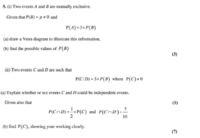
The question is framed a bit trickily. We are initially given
[MATH]0 < \text {P(B)} \le 1, \text{ P(B)} = p, \text { P(A)} = 3p, \text { and P(A and B)} = 0.[/MATH]
Now, we know [MATH]\text {P(A or B)} \le 1 \implies \text {P(A) + P(B) - P(A and B)} \le 1 \implies[/MATH]
[MATH]3p + p - 0 \le 1 \implies 4p \le 1 \implies 0 < p \le \frac{1}{4} \ \because \ 0 < p.[/MATH]
So you were correct on p the second time round.
Now what is the definition of independent events?
[MATH]\text {C and D are independent} \iff \text {P(C and D)} = \text {P(C)} * \text {P(D).}[/MATH]
And what is the definition of conditional probability?
[MATH]\text {p(D)} \ne 0 \implies \text {P(C | D)} \equiv \dfrac{\text {P(C and D)}}{\text {P(D)}}.[/MATH]
[MATH]\therefore \text {p(D)} \ne 0 \implies \text {P(C and D)} = \text {P(C | D)} * \text {P(D).}[/MATH]
Now you are absolutely correct that
[MATH]\text {C and D are independent} \implies \text {P(C and D)} = \text {P(C)} * \text {P(D)} \implies[/MATH]
[MATH] \dfrac{\text {P(C and D)}}{\text {P(D)}} \implies \text {P(C)} = \text {P(C | D)} = 3p \implies[/MATH]
[MATH]\text {P(C)} \ne 3p \implies \text {C and D are not independent.}[/MATH]
But has there yet been given any reason given why P(C) cannot equal 3p? Not that I can see. So it is possible based on the information so far that C and D are independent. Of course it is also possible that C and D are not independent. Just knowing P(C | D) is not enough information to make that determination. It is possible but not certain that they are independent.
Then you are given further information about C and D. That information supposedly will allow you to compute P(C), which in turn will let you determine whether C and D are independent.