Probability

ry7

New member
Joined
Jul 16, 2019
Messages
14
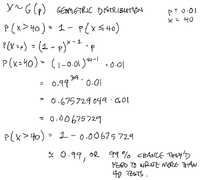
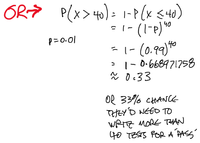
Please help! I think this is a geometric distribution but I’ve figured it out a couple different ways, with 2 very different answers (!)

Question: A university student this writing a multiple choice test with 20 questions. Eachquestio o the test has 4 choices for an answer, one of which is the correct one. To pass the test, the student must get at least 50% of the answers correct. The student has no idea what any of the correct answers are, and so guesses on all the questions. Calculate, to the nearest %, the probability that:

If the student were to write tests like this until they passed one of them, they would need to write more than 40 tests.
13171


13172
 
Neither of your two answers are correct. From context, I can guess that you're using the random variable \(X\) to stand for the number of tests that the student has to take. Assuming this guess is correct, then you're also correct that \(X\) will follow a geometric distribution and you have the formula correct. However, I don't understand where you came up with \(p = 0.01\). This, to me, is a great example of why you should always carefully think about, and write down in words, what each variable stands for. That will help you get an intuition of whether a value assigned to a variable makes sense or not.

Here, you're using \(p\) to stand for the probability that the student passes a test. But given that definition, it doesn't make sense to have \(p = 0.01\). Suppose the test only had two questions. What is the probability the student would pass that test? Well, to pass, they must guess at least half of the questions correctly. Since the test has two questions, "at least half" is the same as "at least one," which is the same as "not zero." So what's the probability the student will guess zero questions correctly? Well, to do that they'd have to answer both incorrectly which means the probability the student will pass the test is \(p = 1 - P(\text{"exactly zero"}) = 1 - \left( \frac{3}{4} \cdot \frac{3}{4} \right) = \frac{7}{16}\).

Next suppose the test had four questions. Now "at least half" means "at least two," so that makes the probability the student will pass the test \(p = P(\text{"at least half"}) = 1 - \biggr[ P(\text{"exactly one"}) + P(\text{"exactly zero"}) \biggr] \). How might you calculate each of these values? Are you noticing a pattern? \(p\) itself is governed by how many questions are on the test, but what's the relationship? What happens when there's 20 questions on the test, as stated in the problem text?
 
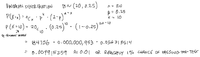
I got p=0.01 (the probability of passing the test) the following way:

13173
 
Oh! Oops! That's my mistake. I... uh... didn't actually bother doing the calculation, my gut instinct just told me it couldn't possibly be 1%. :oops: :oops: Regardless of my own goof, I still stand by my assessment that neither answer are correct. You've now correctly determined \(p \approx 0.01\) and:

\(\displaystyle P(X = 40) \approx 0.99^{39} \cdot 0.01\)

But the key thing is the equals symbol. What you really want is the probability the student needs less than 40 tests:

\(\displaystyle P(X \leq 40) = P(X = 40) + P(X = 39) + P(X = 38) + \cdots + P(X = 0)\)

\(\displaystyle \approx \left[ 0.99^{39} \cdot 0.01 \right] + \left[ 0.99^{38} \cdot 0.01 \right]+ \left[ 0.99^{37} \cdot 0.01 \right] + \cdots + 0.01\)

\(\displaystyle \approx 0.01 \cdot \left[ 0.99^{39} + 0.99^{38} + 0.99^{37} \cdots + 1 \right]\)

Can you finish up from here?
 
Top