Q from 2016 NATED N3 Exam: (a^(1/3) - a^(-2/3))(a + a^(-1) - 2)^(-1)

godfreyjh

New member
Joined
Jan 16, 2017
Messages
11
Dear Friends

I am having trouble with the following question. It comes from the 2016 Nated N3 Exam written in November.

It is from Question 1.1.2

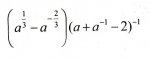
. . .\(\displaystyle \large{ \left(\, a^{\frac{1}{3}}\, -\, a^{-\frac{2}{3}}\,\right)\, (a\, +\, a^{-1}\, -\, 2)^{-1} }\)

I have tried my hand at this question to the point it is vexing me. I have come to a number of possible solutions.

Out of the possible solutions I have managed to put together this answer seems the most reasonable.

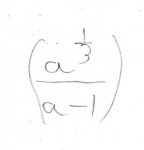
. . .\(\displaystyle \large{ \left(\, \dfrac{a^{\frac{1}{3}}}{a\, -\, 1}\,\right) }\)

How ever I am not sure of myself and would appreciate some guidance and a solution with working if possible.

In closing I have asked for a copy of the marking memorandum which so far my requests for have been declined.

You time and assistance in this matter would be much appreciated.

Thank you

Godfrey
 

Attachments
  • Qiestion_1_1_2.jpg
    Qiestion_1_1_2.jpg
    10.6 KB · Views: 18
  • Qiestion_1_1_2_answer.jpg
    Qiestion_1_1_2_answer.jpg
    6.7 KB · Views: 24
Last edited by a moderator:
Dear Friends

I am having trouble with the following question. It comes from the 2016 Nated N3 Exam written in November.

It is from Question 1.1.2

. . .\(\displaystyle \large{ \left(\, a^{\frac{1}{3}}\, -\, a^{-\frac{2}{3}}\,\right)\, (a\, +\, a^{-1}\, -\, 2)^{-1} }\)

I have tried my hand at this question to the point it is vexing me. I have come to a number of possible solutions.

Out of the possible solutions I have managed to put together this answer seems the most reasonable.

. . .\(\displaystyle \large{ \left(\, \dfrac{a^{\frac{1}{3}}}{a\, -\, 1}\,\right) }\)

How ever I am not sure of myself and would appreciate some guidance and a solution with working if possible.

In closing I have asked for a copy of the marking memorandum which so far my requests for have been declined.

You time and assistance in this matter would be much appreciated.

Thank you

Godfrey
Your answer is correct.
 
Last edited by a moderator:
No, the user's answer is incorrect. For example, test the original expression with a = 8 and work it out to one fraction.

And substitute a = 8 in the user's solution. Compare those results.

The answer given IS correct. It can be shown algebraically.

When you substitute a=8 you get 2/7 in both cases.
 
I'm wondering if lookagain perhaps made the same mistake I initially did. The OP's handwritten solution is a bit sloppy, and when I first read it, I thought it was as follows:

\(\displaystyle \dfrac{a^\frac{1}{3}}{a^{-1}}\)

The above is most definitely not the correct answer:

\(\displaystyle \dfrac{a^{\frac{1}{3}}-a^{-\frac{2}{3}}}{a+\dfrac{1}{a}-2}\ne a^{\frac{4}{3}}\)

I could easily see how someone else might make the same mistake. Upon further reflection, I see now that what the OP actually wrote was this:

\(\displaystyle \dfrac{a^\frac{1}{3}}{a-1}\)

Which is an equivalent expression to the given.
 
No, the user's answer is incorrect. For example, test the original expression with a = 8 and work it out to one fraction.

And substitute a = 8 in the user's solution. Compare those results.
attachment.php


(2 - 1/4) / (8 + 1/8 - 2)

= (7/4)/(49/8)

= 2/7

Then:

81/3/(8-1) = 2/7

Where is the problem? What did you get LA??
 
attachment.php


(2 - 1/4) / (8 + 1/8 - 2)

= (7/4)/(49/8)

= 2/7

Then:

81/3/(8-1) = 2/7

Where is the problem? What did you get LA??

I think the problem is that some read it as \(\displaystyle \frac{a^{\frac{1}{3}}}{a^{-1}}\) rather than \(\displaystyle \frac{a^{\frac{1}{3}}}{a-1}\).
 
Last edited:
No, the user's answer is incorrect. For example, test the original expression with a = 8 and work it out to one fraction. And substitute a = 8 in the user's solution. Compare those results.
Simple Algebra: \(\displaystyle \begin{gathered} \left( {{a^{1/3}} - {a^{ - 2/3}}} \right){\left( {a + {a^{ - 1}} - 2} \right)^{ - 1}}\\\left( {\frac{{a - 1}}{{{a^{2/3}}}}} \right){\left( {\frac{{{a^2} - 2a + 1}}{a}} \right)^{ - 1}} \\\left( {\frac{{a - 1}}{{{a^{2/3}}}}} \right)\left( {\frac{a}{{{{(a - 1)}^2}}}} \right)\\\left( {\frac{{{a^{1/3}}}}{{a - 1}}} \right)\\\end{gathered}\)
 
Where is the problem? What did you get LA??

Here is the problem. Though a = 8 actually checks in the original and in the OP's final expression,

those two are not equivalent expressions.

Variable a cannot equal 0 in the given expression, but it can equal 0 in the OP's final expression.
 
Here is the problem. Though a = 8 actually checks in the original and in the OP's final expression, those two are not equivalent expressions.
Variable a cannot equal 0 in the given expression, but it can equal 0 in the OP's final expression.

The domain of the expression \(\displaystyle \left( {{a^{1/3}} - {a^{ - 2/3}}} \right){\left( {a + {a^{ - 1}} - 2} \right)^{ - 1}}\) is \(\displaystyle \mathbb{R}\setminus \{0,1\}\)

On that domain, \(\displaystyle \mathbb{R}\setminus \{0,1\}\), is it true that
\(\displaystyle \left( {{a^{1/3}} - {a^{ - 2/3}}} \right){\left( {a + {a^{ - 1}} - 2} \right)^{ - 1}}\equiv\left( {\dfrac{{{a^{1/3}}}}{{a - 1}}} \right)~?\)
 
Last edited by a moderator:
Top