cicocicobum
New member
- Joined
- Sep 10, 2020
- Messages
- 4
Dear All,
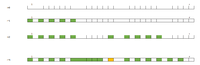
In the frame of an electronic project for Uni I have encountered a problem that I cannot solve.
I need to calculate the probability of collision of radar pulses in relation to the number of radars.
In my mind I structured the problem analogously to a problem of pick probability with replacement (or without?). I put in parenthesis the analogy.
I consider:
- r the TOTAL number of pulse slots (population of numbers available).
- u the number of emitted pulses (numbers extracted at each pick)
- n the number of radars (picks)
The event is: x pulse(s) collide (pick a number/numbers that have been already extracted by previous picks)
How should I express p(e)?
I have tried with Bernoulli formula for n indepentend Bernoulli trials where:
p_fav=u/r = collision
p_unfav=(1-pfav) = no collision
but I am not convinced because:
- p and 1-p change with n (so they are possibly not independent trials)
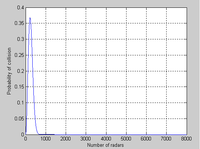
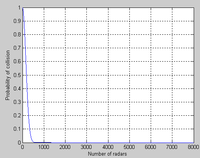
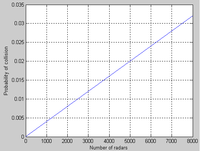
- the resulting probability has a bell shape (!) because p_unfav tends to zero after a certain number of pulses and the whole probability becomes 0 while I would expect that with increasing radars (higher n) involved the probability becomes higher.
I checked and [ p(at least one collision)] effectively becomes 1 after a certain number of radars so p_unfav has to be 0.
How should I analyze the problem?
Thanks in advance for your time.
In the frame of an electronic project for Uni I have encountered a problem that I cannot solve.
I need to calculate the probability of collision of radar pulses in relation to the number of radars.
In my mind I structured the problem analogously to a problem of pick probability with replacement (or without?). I put in parenthesis the analogy.
I consider:
- r the TOTAL number of pulse slots (population of numbers available).
- u the number of emitted pulses (numbers extracted at each pick)
- n the number of radars (picks)
The event is: x pulse(s) collide (pick a number/numbers that have been already extracted by previous picks)
How should I express p(e)?
I have tried with Bernoulli formula for n indepentend Bernoulli trials where:
p_fav=u/r = collision
p_unfav=(1-pfav) = no collision
but I am not convinced because:
- p and 1-p change with n (so they are possibly not independent trials)
- the resulting probability has a bell shape (!) because p_unfav tends to zero after a certain number of pulses and the whole probability becomes 0 while I would expect that with increasing radars (higher n) involved the probability becomes higher.
I checked and [ p(at least one collision)] effectively becomes 1 after a certain number of radars so p_unfav has to be 0.
How should I analyze the problem?
Thanks in advance for your time.