Rational exponent

jpanknin

Junior Member
Joined
Jan 8, 2020
Messages
142
For the problem [imath]((-1)^2)^{1/2}[/imath] it seems there are two valid ways to go about it, but you get two different answers.

Method 1: First calculate [imath](-1)^2 = 1[/imath] and then take the square root of [imath]1^{1/2} = 1[/imath].

Method 2: First multiply the exponents as in [imath](-1)^{2*1/2} = (-1)^1 = -1[/imath].

Method 3: Switch the exponents [imath]((-1)^{1/2})^2[/imath] and try to first take the square root of -1, but this is invalid.

The first two both seem valid to me in that they use valid exponent rules, but give different answers. So what am I missing and how would you handle this kind of situation?
 
Last edited:
Beer induced ramblings follow.
For the problem [imath]((-1)^2)^{1/2}[/imath] it seems there are two valid ways to go about it, but you get two different answers.

Method 1: First calculate [imath](-1)^2 = 1[/imath] and then take the square root of [imath]1^{1/2} = 1[/imath].

Method 2: First multiply the exponents as in [imath](-1)^{2*1/2} = (-1)^1 = -1[/imath].

Method 3: Switch the exponents [imath]((-1)^{1/2})^2[/imath] and try to first take the square root of -1, but this is invalid.

The first two both seem valid to me in that they use valid exponent rules, but give different answers. So what am I missing and how would you handle this kind of situation?

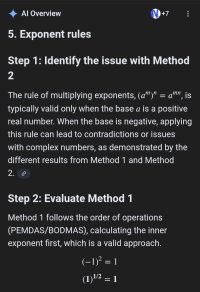
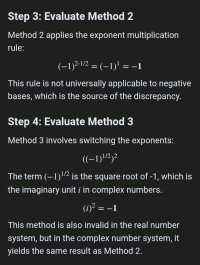
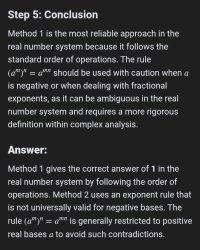
Let us again consult the magic Google AI god.

Screenshot_20251220-071012_Google.jpgScreenshot_20251220-071021_Google.jpgScreenshot_20251220-071032_Google.jpg

All hail the magic Google AI conch!

 
square root of 11/2=11^{1/2} = 111/2=1.
\(\displaystyle \sqrt{1}= \pm {1}\) = this is where it is useful to use complex representation

1 = cos[(2n+1)*π/2] + i * sin[(2n+1)*π/2]
 
Last edited:
\(\displaystyle \sqrt{1} \ = \ 1 \ \) only, as \(\displaystyle \ f(x) \ = \ \sqrt{x} \ \) is a single-valued function.
Why are you treating it as a function? And why prefer the positive value over the negative one for the function's correspondence?
 
Why are you treating it as a function? And why prefer the positive value over the negative one for the function's correspondence?
See my answer to your other question.

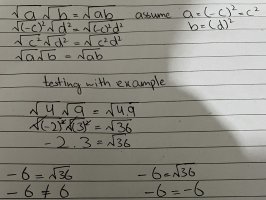
The second question here is worth pondering. Can you see why using the negative root might cause trouble? (Hint: think about rules for working with radicals, such as [imath]\sqrt{a}\sqrt{b}=\sqrt{ab}[/imath].)
 
See my answer to your other question.

The second question here is worth pondering. Can you see why using the negative root might cause trouble? (Hint: think about rules for working with radicals, such as [imath]\sqrt{a}\sqrt{b}=\sqrt{ab}[/imath].)
So I am guessing the issue is still that there are two possible values for square root, which is fundamentally against algebra where one unique outcome is required for an input.

IMG_1016.jpeg
 
which is fundamentally against algebra where one unique outcome is required for an input.
It is true that non-integer powers, of which square root is a special case, are not functions in the classical sense.
 
So I am guessing the issue is still that there are two possible values for square root, which is fundamentally against algebra where one unique outcome is required for an input.

View attachment 39925
Do you see your inconsistency here? If you are taking negative roots, then how is [imath]\sqrt{9}=3[/imath]?

And have you not learned that it is not always true that [imath]\sqrt{a^2}=a[/imath]? That is only true when [imath]a\ge0[/imath] (using the traditional definition as the positive root). Instead, we say that [imath]\sqrt{a^2}=|a|[/imath]. If we used negative roots, we would have to say [imath]\sqrt{a^2}=-|a|[/imath]. Either way, the rule you are claiming can't be true!
It is true that non-integer powers, of which square root is a special case, are not functions in the classical sense.
Yes, this is a point that arose in the original discussion in this thread, e.g. #3, and "step 5"; I don't think we're talking about that any more, but it is lurking in the background.

In particular, for non-integer powers, we have to be very careful with all the rules, one way or another.
 
Do you see your inconsistency here? If you are taking negative roots, then how is 9=3\sqrt{9}=39=3?
I wasn't doing my work here under the assumption that we could only take the positive or negative root, but I understand your point now.
 
Top