I found that we can find harmonic mean through the next formula(second way to find): Har.mean= Geo.mean(square)/Arith.mean . I checked that formula in several sequences of numbers. Then I have revealed that this formula works with given 2 numbers(numbers>0) and with geometrical progression sequence. However, when I used that one with a random sequence or with arithmetical progression, the above formula did not give the right answer. Why?

You are using an out of date browser. It may not display this or other websites correctly.
You should upgrade or use an alternative browser.
You should upgrade or use an alternative browser.
Relationship between arithmetical, geometrical and harmonical mean
- Thread starter Doszhan
- Start date
D
Deleted member 4993
Guest
Please post an example of that anomaly.I found that we can find harmonic mean through the next formula(second way to find): Har.mean= Geo.mean(square)/Arith.mean . I checked that formula in several sequences of numbers. Then I have revealed that this formula works with given 2 numbers(numbers>0) and with geometrical progression sequence. However, when I used that one with a random sequence or with arithmetical progression, the above formula did not give the right answer. Why?

Dr.Peterson
Elite Member
- Joined
- Nov 12, 2017
- Messages
- 16,974
The real question to ask is, under what special conditions does your relationship hold? You should not be surprised that it isn't always true; you should be surprised instead that it is true for the special cases you found. The latter is where you need to ask "why".
What are the cases you found where it works? Have you proved that it is always true for those types of sequence?
Now, there is a general inequality connecting these three means; if your equation were always true, we would just use that rather than the inequality!
What are the cases you found where it works? Have you proved that it is always true for those types of sequence?
Now, there is a general inequality connecting these three means; if your equation were always true, we would just use that rather than the inequality!
For example, geometrical progression is given.Please post an example of that anomaly.
1 3 9 27 81 243 729.
Let's find means Arith.mean= 156.143; Geo.mean=27; Harm= 4.67;
Use that formula: 27'2/156.143= 4.67(equation works)
2) Let's choose arithmetical mean:
1 3 5 7 9 11
Arith.mean=6 Geo.mean=4.6717 Harm.mean=3.1945
4.6717'2/6= 3.637( different wrong answer)
3) It is curious thing that the formula works with two nonequal and positive numbers:
1 4
Arith.mean=25; Geo.mean=2; Harm.mean=1.6;
2'2/2.5=1.6(equality works)
Dr.Peterson
Elite Member
- Joined
- Nov 12, 2017
- Messages
- 16,974
Can you prove that the equation is true for any geometric progression? Give it a try.
If you can, then note that any two numbers form a geometric progression, so your third point will follow from the first. The second is just evidence that your equation is not always true; and there was no reason to expect it to be.
Of course, it will also be easy to show whether it is true for any two numbers, by just writing the expressions for the three means, and checking whether HM*AM = GM^2. Have you tried that?
If you can, then note that any two numbers form a geometric progression, so your third point will follow from the first. The second is just evidence that your equation is not always true; and there was no reason to expect it to be.
Of course, it will also be easy to show whether it is true for any two numbers, by just writing the expressions for the three means, and checking whether HM*AM = GM^2. Have you tried that?
Dr.Peterson
Elite Member
- Joined
- Nov 12, 2017
- Messages
- 16,974
I was able to prove the statement for both cases, the geometrical progression in general, and the case of two positive numbers. You've disproved it for other examples, demonstrating that it is not always true.
Here is the proof for two numbers, a and b:
Here is the proof for two numbers, a and b:
[MATH]GM = \sqrt{ab}[/MATH]
[MATH]AM = \frac{a+b}{2}[/MATH]
[MATH]HM = \frac{2}{\frac{1}{a}+\frac{1}{b}} = \frac{2ab}{a+b}[/MATH]
[MATH]AM\cdot HM = \frac{a+b}{2}\frac{2ab}{a+b} = ab = GM^2[/MATH]
Okay, thank you a lot Dr.Peterson.I was able to prove the statement for both cases, the geometrical progression in general, and the case of two positive numbers. You've disproved it for other examples, demonstrating that it is not always true.
Here is the proof for two numbers, a and b:
[MATH]GM = \sqrt{ab}[/MATH][MATH]AM = \frac{a+b}{2}[/MATH][MATH]HM = \frac{2}{\frac{1}{a}+\frac{1}{b}} = \frac{2ab}{a+b}[/MATH][MATH]AM\cdot HM = \frac{a+b}{2}\frac{2ab}{a+b} = ab = GM^2[/MATH]
Currently, I am making some research on that topic and can I ask a question?
In my research, I tried to find means of AM, GM and HM values(Yeah, I find means of means)) ) in order to make a comparison between them. I noticed some next things:
1) If we find means of geometrical progression, the formula(HM=GM^2/AM) is done(Initially, I thought it works everywhere, but I was wrong)
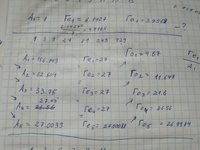
2) If we find the second row of means AM2, GM2 and HM2 from values of previous AM, GM and HM, GM2 will be equal with GM1. It means that if we find means of means, Geometric mean remains the same, whilst the AM value decreases and HM value increases(below picture show that).
3) Through some transformation of formulas(You can see it in below pdf document), I find formula HMn=GM1^2/AMn. I used that one to prove the inequality of AMn>=GMn>=HMn and AMn-GMn>GMn-HMn(detail presentation in pdf)
Now, I have this amount of collected data. I need to do further research and find some implementation of this research work, but I get in stuck and therefore I am asking experts to some advice. Do you know any fields(math exercises or smth else), where I can do further work?
Of course, I am asking another hard question, and maybe I want a lot, and you can ignore my question, but let's try the fortune. Can you look at my research?
P.S. I am studying MATH in my native language, as a result, I have some problems with English. I hope I could write everything if you have questions, please ask it
Thank you a lot for your time and attention.