Second derivative?

apple2357

Full Member
Joined
Mar 9, 2018
Messages
550
The graphs of y=x^(5/3) has a point of inflection of x=0 and so does y=x^(7/3). The graphs look very similar.

But the second derivative is zero for one and infinite for the other. How does this manifest in the sketches? How can I see an infinite rate of change on the underlying graph? I would have assumed it was zero there too.
 
To be an inflection point, there must be a change in concavity. Neither the first derivative nor the second derivative has to exist at an inflection point.
 
It isn't always easy to visualize the second derivative, even from a very accurate graph, much less a "sketch".

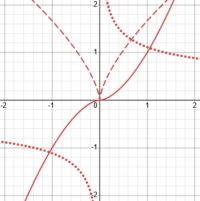
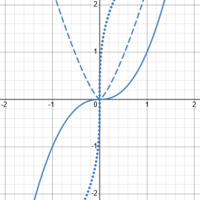
Here (red) is x^(5/3) (solid), with its first (dashes) and second (dots) derivatives, and (blue) the same for x^(7/3):

1780067770193.png 1780067846705.png

The first changes a little more suddenly, so that the first derivative leaps vertically, making the second derivative infinite.

The second changes slope a little more gradually, but this time the second derivative is vertical, in much the same way the first derivative of the first was. I can't say I have any special ability to see that in the graphs of the functions themselves. It is what it is.
 
Thank you. So to clarify:

If a curve flattens or straightens near a point, i normally assumed the second derivative was zero there ( like x^3) but realised looking at the graph alone is not enough to say whether the second derivative is zero or infinite at that point! And given there are so far apart, i would expect the difference to be reflected in the underlying functions somehow. Doesn't look like there is. In the derivatives there are clear difference in the way you have highlighted above. Thanks again.
 
Top