Simple Concavity Question

poipoipoi10

New member
Joined
Nov 19, 2011
Messages
6
The function y=f(x) has second derivative y''= ebjhknmhoddbobhanjmchmocnm.gif. Find the intervals on which y=f(x) is concave down. Give your answer using interval notation. Use infinity U for union if required.
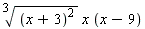
 
The function y=f(x) has second derivative y''= View attachment 1482. Find the intervals on which y=f(x) is concave down. Give your answer using interval notation. Use infinity U for union if required.

What is the sign of f"(x) when the function is concave down?

Please share your work with us, indicating exactly where you are stuck - so that we may know where to begin to help you.
 
Last edited by a moderator:
What is the sign of f"(x) when the function is concave down?

Please share your work with us, indicating exactly where you are stuck - so that we may know where to begin to hep you.

Well the sign should be negative, I went on youtube to try and find out how I can do this question. I found that you have to make the function =0 and find basically the x-intercepts. So in this case wouldn't they be: -3,0, and 9. The table just confuses me because I dont know how to set up the intervals.

I've been looking around the internet on how to do this kind of stuff for quite a bit. I seem to understand the simpler questions but a bigger one like this confuses me.
 
When y" is positive, y is concave upward; when y" is negative, y is concave downward.
 
When y" is positive, y is concave upward; when y" is negative, y is concave downward.

I understand that, but is my thought process correct? Finding the points of inflection (-3,0 and 9) then putting it on a table with the intervals of (-infinity,-3), (-3,0), (0,9) and (9,infinity). Then taking a number from each interval and plugging into into the second derivative equation to see if it it positive or negative.
 
I understand that, but is my thought process correct? Finding the points of inflection (-3,0 and 9) then putting it on a table with the intervals of (-infinity,-3), (-3,0), (0,9) and (9,infinity). Then taking a number from each interval and plugging into into the second derivative equation to see if it it positive or negative.

Your thought process is correct.

If f"(x) is positive, then f(x) is concave up on that interval. If negative: then on that interval f(x) is concave down.

\(\displaystyle \begin{tabular}{|c||c|c|c|c|} \hline
~ & (-\infty,-3) & (-3,0) & (0,9) & (9,\infty) \\ \hline \hline
f''(x) & + & + & - & +\\ \hline
f(x) & Concave up & Concave up & Concave down & Concave up\\
\hline
\end{tabular}\)
 
Last edited:
Your thought process is correct.

If f"(x) is positive, then f(x) is concave up on that interval. If negative: then on that interval f(x) is concave down.

\(\displaystyle \begin{tabular}{|c||c|c|c|c|} \hline
~ & (-\infty,-3) & (-3,0) & (0,9) & (9,\infty) \\ \hline \hline
f''(x) & + & + & - & +\\ \hline
f(x) & Concave up & Concave up & Concave down & Concave up\\
\hline
\end{tabular}\)

Ugh I did all that and I found the only negative interval to be (0,9) which is incorrect. Can anyone please tell me if I'm doing anything wrong etc. Thanks.
 
Ugh I did all that and I found the only negative interval to be (0,9) which is incorrect. Can anyone please tell me if I'm doing anything wrong etc. Thanks.

What do you mean it is incorrect?

It is correct. f(x) is only concave down on the interval (0,9)

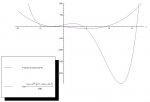
Look at this graph


Untitled-1.jpg
As you can see f''(x) is only negative on the interval (0,9). I also graphed the original function f(x) so you can see that it is only concave down on this interval. Note: for some reason Wolfram Mathematica is refusing to plot points less than -3. However, my TI-89 has no problem doing this - I assure you f''(x) is positive from \(\displaystyle (-\infty,-3)\)
 
Note: for some reason Wolfram Mathematica is refusing to plot points less than -3. However, my TI-89 has no problem doing this - I assure you f''(x) is positive from \(\displaystyle (-\infty,-3)\)

You'll get same refusal from excel or other "programming" softwares - those loath to take fractional exponents of negative numbers (fear of imaginary domain - I suppose). At one time pka had explained the correctness of such refusal - may be he can shade some more light onto it!!!
 
The hint for the question says: remember y''(x)<0 is NOT the same as concave down. For example f(x)=-x^5 is concave up on [0,infinity) but has a negative second derivative on (0,infinity).

Basically what I believe it's saying is that (0,9) is an interval where it's concave down in regards to the second derivitive graph but where is the original graph concave down.

By the way this is in an integration module so I'm not sure if I should apply any of that because our prof likes to mix things up sometimes.

I'm really sorry to keep asking for your help but this simple question has just confused me so much.:mad:
 
Last edited:
The hint for the question says: remember y''(x)<0 is NOT the same as concave down. For example f(x)=-x^5 is concave up on [0,infinity) but has a negative second derivative on (0,infinity).

Basically what I believe it's saying is that (0,9) is an interval where it's concave down in regards to the second derivitive graph but where is the original graph concave down.

By the way this is in an integration module so I'm not sure if I should apply any of that because our prof likes to mix things up sometimes.

I'm really sorry to keep asking for your help but this simple question has just confused me so much.:mad:

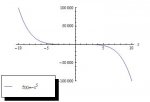
Untitled-2.jpg

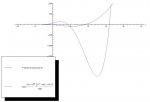
You are telling me this graph is concave up from \(\displaystyle [0,\infty)\)?

Is this from a text book? or your professors notes?

Because that statement is dead wrong.
 
It's from an assignment.
The entire question is:

The function
kkjocpccbiabghephpaehnocpe.gif
has second derivative
lbebkakkedcblclbnhjljfeljm.gif
ebjhknmhoddbobhanjmchmocnm.gif
. Find the intervals on which
oaklnimadmemdgfolmicjndfgm.gif
is concave down. Give your answer using interval notation. Use infinity for
mehmjmcglehlpdhlkokefgiamk.gif
and U for union.


Hint: Concave down is NOT the same as
ghegobedadbkbaajheaoabhoec.gif
0. For example,
bhpfhnengadhjcfbhfoclebagf.gif
is concave up on
henkapnnbndminpppogjfjoihp.gif
but has negative second derivative on
epkekmlbhfjfggekciahejgmkh.gif


Thats all it says.
If you can't do anything about it or if you feel it's incorrect thats completely fine as you've helped me enough.
 
You'll get same refusal from excel or other "programming" softwares - those loath to take fractional exponents of negative numbers (fear of imaginary domain - I suppose). At one time pka had explained the correctness of such refusal - may be he can shade some more light onto it!!!

Ah yes, after looking into this I came across the fowling:

"Given a number
Inline1.gif
, the cube root of
Inline2.gif
, denoted
Inline3.gif
or
Inline4.gif
(
Inline5.gif
to the 1/3
power), is a number
Inline6.gif
such that
Inline7.gif
. Every real number has a unique real cube root, and every nonzero complex number has three distinct cube roots.

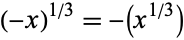
The schoolbook definition of the cube root of a negative number is
Inline8.gif
. However, extension of the cube root into the
complex plane gives a branch cut along the negative real axis for the principal value of the cube root. By convention, "the" (principal) cube root is therefore a complex number with positive imaginary part. As a result, Mathematica and other symbolic algebra programs that return results valid over the entire complex plane therefore return complex results for
Inline9.gif
. For example, in
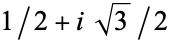
Mathematica, ComplexExpand[(-1)^(1/3)] gives the result
Inline10.gif
. In versions of
Mathematica prior to 6.0, this behavior could be changed by loading the package Miscellaneous`RealOnly`. The cube root of a number
Inline11.gif
can be computed using
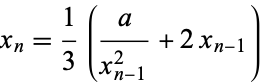
Newton's method by iteratively applying

NumberedEquation1.gif
for some real starting value
Inline12.gif
."


Here is an updated version of the graph now:

Untitled-1.jpg
 
Top