Simple Short Question about Probability: lottery consists of 200 tickets and two prizes. 1st prize ticket is drawn and then, w/o replacement,...

Masaru

Junior Member
Joined
Sep 6, 2013
Messages
66
I have a problem with the following question:

A small lottery consists of 200 tickets. There are two prizes. The first prize ticket is drawn and then, without replacement, the second prize ticket is drawn. If you buy two tickets, what are your chances of winning

a) first prize
b) both prizes?

My answers for the above questions would be:

a) 1/200
b) (1/200) X (1/199) = 1/39800

But the answer section in the book says:

a) 1/100
b) (1/100) X (1/199) = 1/19900

I don't understand why the answer for a) is 1/100, not /200, because you draw a ticket one at at time and you have only ONE first prize ticket and ONE second ticket in 200 tickets. So when you draw the first ticket, you have 1/200 chance of winning the first prize, then when you draw the second one, you have 1/199 chance of winning the second prize.

If anybody can see anything wrong with my understanding of this question or my approach, please let me know and explain it to me clearly so that I can understand.

Thank you.
 
a) first prize
b) both prizes?
Does "first prize" mean "one prize", i.e. are the prizes the same, or is the first prize different from the second ?
The answer section seems to mean that the prizes are the same. If that's the case how do you get 1/200 ?
 
I don't understand why the answer for a) is 1/100, not 1/200. So when you draw the first ticket, you have 1/200 chance of winning the first prize, then when you draw the second one, you have 1/199 chance of winning the second prize.

If anybody can see anything wrong with my understanding of this question or my approach, please let me know and explain it to me clearly so that I can understand.
It's not 1/200 at a) because you bought two tickets and the probability of getting a prize on the first draw is, therefore, 2/200 (which is equal to 1/100). 🤷‍♂️

You then only have one (valid) ticket left for the second draw (because one of your tickets has already won the first prize and may, therefore, be discarded/disregarded) but I believe you already understand that part.

Does that clear up your misunderstanding?

Hope that helps. 😊
 
Last edited:
A small lottery consists of 200 tickets. There are two prizes. The first prize ticket is drawn and then, without replacement, the second prize ticket is drawn. If you buy two tickets, what are your chances of winning

a) first prize
b) both prizes?
Does "first prize" mean "one prize", i.e. are the prizes the same, or is the first prize different from the second ?
The answer section seems to mean that the prizes are the same. If that's the case how do you get 1/200 ?
As I understand it, all tickets are the same, but the first ticket drawn wins one prize (perhaps bigger), and the second ticket drawn wins a different prize.

So winning first prize just means that one of your 2 tickets is drawn first, with probability 2/200 = 1/100.

And winning second prize means that one of your tickets (the one remaining, given that you won first prize) is drawn, with probability 1/199.
 
Thank you so much for your help, Blamocur, The Highlander, and Dr. Peterson.

So, if you bought 100 tickets, for example,

the answer for a) would be
100/200 = 1/2,

and the answer for b) would be
(100/200) X (99/199) = 99/398

Correct???

 
Thank you so much for your help, Blamocur, The Highlander, and Dr. Peterson.

So, if you bought 100 tickets, for example,

the answer for a) would be
100/200 = 1/2,

and the answer for b) would be
(100/200) X (99/199) = 99/398

Correct???

Yes.
 
I have a problem with the following question:

A small lottery consists of 200 tickets. There are two prizes. The first prize ticket is drawn and then, without replacement, the second prize ticket is drawn. If you buy two tickets, what are your chances of winning

a) first prize
b) both prizes?

My answers for the above questions would be:

a) 1/200
b) (1/200) X (1/199) = 1/39800

But the answer section in the book says:

a) 1/100
b) (1/100) X (1/199) = 1/19900

I don't understand why the answer for a) is 1/100, not /200, because you draw a ticket one at at time and you have only ONE first prize ticket and ONE second ticket in 200 tickets. So when you draw the first ticket, you have 1/200 chance of winning the first prize, then when you draw the second one, you have 1/199 chance of winning the second prize.

If anybody can see anything wrong with my understanding of this question or my approach, please let me know and explain it to me clearly so that I can understand.

Thank you. Gambling can be a lot like these lottery problems - sometimes it's about understanding the odds and sometimes it's just about getting lucky. When it comes to betting, whether you're into slots, blackjack, or poker, the thrill of taking chances is what draws people in. If you're looking to level up your game, it's important to check out the right platforms. For instance, fgfox online casino offers a great mix of games like roulette and jackpot slots that cater to all types of players. They even have some fantastic promotions that can boost your chances of hitting it big. Just like understanding the odds in a lottery, knowing where to play makes all the difference. So, next time you’re looking to spin the wheel or make a bet, this site might be worth a look!
Yeah, the reason the book (and most people here) say 1/100 for part a) is just because you bought two tickets, so you’ve got 2 chances out of the 200 to have one drawn first.
 
I interpreted the first question (part a) as saying that the player wins the first prize and only the first prize. With that assumption I get

[imath]P(\text{win first prize only})=\dfrac{1}{200}+\dfrac{198}{200}\cdot \dfrac{1}{198}=\dfrac{1}{100}=0.01[/imath]
 
I interpreted the first question (part a) as saying that the player wins the first prize and only the first prize. With that assumption I get

[imath]P(\text{win first prize only})=\dfrac{1}{200}+\dfrac{198}{200}\cdot \dfrac{1}{198}=\dfrac{1}{100}=0.01[/imath]
Did you miss the fact that you have two tickets?
If you buy two tickets, what are your chances of winning

a) first prize
b) both prizes?
 
Did you miss the fact that you have two tickets?
I don't believe so. Either he wins by drawing the top prize with the first ticket (1/200) or the second ticket ... but to draw the top prize on the second ticket his first draw must be one of the 198 losing tickets. so (198/200) x (1/198). Finally, add the two.

On the other hand, I guess I'm assuming that if he draws the top prize with the first ticket, he doesn't even bother to draw a second ticket.
 
Hmm ... the more I think about this, the more confused I become. I think what I'm trying to calculate is the probability that the player draws two tickets and wins ONLY the top prize. I that case:

[math]\dfrac{1}{200}\cdot \dfrac{198}{199}+ \dfrac{198}{200}\cdot \dfrac{1}{198} \approx 0.00997[/math]
 
I don't believe so. Either he wins by drawing the top prize with the first ticket (1/200) or the second ticket ... but to draw the top prize on the second ticket his first draw must be one of the 198 losing tickets. so (198/200) x (1/198). Finally, add the two.

On the other hand, I guess I'm assuming that if he draws the top prize with the first ticket, he doesn't even bother to draw a second ticket.
No, he doesn't "draw" a second ticket after the first fails; he HAS two tickets, before the two winners are drawn. At least that's how any lottery (better called a "raffle" in a simple case like this) I've heard of works. Either of his two tickets could win the first prize.
 
I wanted to check my understanding, so I asked Google "lottery vs raffle?" Here is its AI summary:

A raffle is technically a type of lottery, and both are considered forms of gambling under the law, requiring participants to provide "consideration" (payment) for a chance to win a prize. The primary distinctions are in their typical operation, scale, and prize structure.​
Key Differences​
Feature​
Lottery​
Raffle​
Prizes
Usually large, escalating cash jackpots that may roll over if no winner is found.​
Often physical items (e.g., gift baskets, goods, a car) or set cash amounts, with a winner guaranteed at the time of the draw.​
Scale
Typically large-scale, ongoing operations run by state, national governments, or large official charities.​
Generally smaller-scale events, such as those held by schools, churches, or local non-profits, often as part of a specific event or fundraiser.​
Ticket Process
Participants often choose a set of numbers from a wide range, and the number of matches determines the prize tier. There is no limit to the number of tickets sold.​
Participants are usually given pre-printed tickets with a single unique number. There is often a limited number of tickets available in total.​
Draw Frequency
Draws typically occur on a regular schedule (e.g., weekly).​
Draws usually happen at a single, specific date and time, after all tickets for that event have been sold.​
Regulatory Distinction​
For legal and regulatory purposes, the term "lottery" is often used to refer to both activities, which are highly regulated at the state and federal levels in the United States.​


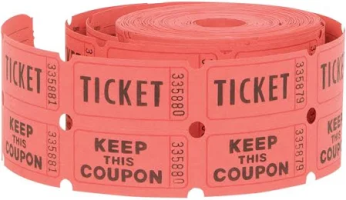
This confirms that the problem, while phrased in terms of a lottery, is specifically about a raffle, in which tickets are drawn after all have been sold; typically tickets come in pairs (see below), one to be kept as proof of purchase, and the other put into the drawing. If you buy two tickets, both will be in the drawing when it is held.

1766850894010.png

It's possible that these terms vary in other places, which could be a source of confusion.
 
No, he doesn't "draw" a second ticket after the first fails; he HAS two tickets, before the two winners are drawn. At least that's how any lottery (better called a "raffle" in a simple case like this) I've heard of works. Either of his two tickets could win the first prize.
Quote from OP: "The first prize ticket is drawn and then, without replacement, the second prize ticket is drawn."
 
Quote from OP: "The first prize ticket is drawn and then, without replacement, the second prize ticket is drawn."
Which is what I said: First you buy two tickets (that is, you keep the coupons and the tickets are put into the jar, among a total of 200); then they draw one and give a prize to its owner, then they draw another and give a second prize.

So you have two tickets in the jar for the first draw (probability 2/200 to win the first prize), and then, if you won that, you still have one ticket in the jar for the second draw (probability 1/199 to win the second prize as well). So the probability of getting both prizes is 2/200*1/199 = 1/19900.

The probability of winning only the first prize (which isn't a question they asked) would be 2/200*198/199 = 198/19900.

And, again, the probability of getting (at least) first prize is 2/200 = 1/100; and the long way to calculate that would be 1/19900 + 198/19900 = 1/100.

I think what I'm trying to calculate is the probability that the player draws two tickets and wins ONLY the top prize.
Once again, I think you are misunderstanding the concept of "drawing". The player does not draw tickets; that is done by the person running the event. The player buys two tickets and they are put into the jar to be drawn (that is, taken out of the jar and read).

I wonder if English is not your first language, or else you just are not familiar with raffles.
 
This is a problem I encounter from time to time in the students I tutor at a community college, many of whom are unfamiliar with both the language and the culture from which math problems are taken. Some textbooks are careful to explain the background of problems, describing the contents of a "standard deck of cards" or how a raffle is done; but not every problem can state all of that fully. So often I have to direct students to where the book did that, or else explain it myself in conversation. And that's why I gave a further explanation above -- yet even that was not quite enough, because I didn't think about how "draw" could be misunderstood.

As I often say, the hardest part of a "word problem" is usually the words, not the math!
 
I have a problem with the following question:

A small lottery consists of 200 tickets. There are two prizes. The first prize ticket is drawn and then, without replacement, the second prize ticket is drawn. If you buy two tickets, what are your chances of winning

a) first prize
b) both prizes?

My answers for the above questions would be:

a) 1/200
b) (1/200) X (1/199) = 1/39800

But the answer section in the book says:

a) 1/100
b) (1/100) X (1/199) = 1/19900

I don't understand why the answer for a) is 1/100, not /200, because you draw a ticket one at at time and you have only ONE first prize ticket and ONE second ticket in 200 tickets. So when you draw the first ticket, you have 1/200 chance of winning the first prize, then when you draw the second one, you have 1/199 chance of winning the second prize.

If anybody can see anything wrong with my understanding of this question or my approach, please let me know and explain it to me clearly so that I can understand.

Thank you. Interesting question about probability, because lotteries are basically the simplest gambling game dressed up as math. When you draw tickets without replacement, it feels a lot like blackjack odds changing after each card, or roulette spins where players think patterns matter. In real casinos and online slots, people forget that probabilities shift depending on the rules, payouts, and prize structure, just like in this 200-ticket lottery example. That’s why jackpot hype can be misleading if you don’t look at the math behind the game. I’ve been digging into different betting platforms lately, and places that clearly explain odds and bonuses stand out, especially sites like https://kaszino-world.com/1000-huf-kaszinok/ which break down low-deposit options in a way that actually makes sense for poker and slot fans. Whether it’s a lottery draw or a poker hand, money games always reward players who understand probability instead of chasing pure luck alone.
You’re basically on the right track, but think about it like this: you bought two tickets out of the 200, so for the first prize draw you have 2 chances in 200, i.e. 2/200=1/1002/200 = 1/1002/200=1/100. That’s why the book says 1/100 for part (a) instead of 1/200 - because either of your two tickets could come up first.
 
You’re basically on the right track, but think about it like this: you bought two tickets out of the 200, so for the first prize draw you have 2 chances in 200, i.e. 2/200=1/1002/200 = 1/1002/200=1/100. That’s why the book says 1/100 for part (a) instead of 1/200 - because either of your two tickets could come up first.
@Zexralo8

Welcome to the forum.

Please read through all the posts already made in a thread before jumping in with a contribution that may be
somewhat redundant.

In addition to the fact that the OP's question may have already been answered (perfectly clearly, so there's certainly little benefit in repeating explanations that have already been given) there is also little point in answering questions that are more than a year old! (The OP isn't still waiting around for a response, lol.)

If you really believe that, having read everything already posted in an old thread, you do have something new and useful to add to it then that's a different matter.

Helpful contributions are always welcome but just wanting to make your presence felt can not only be counter productive but also a waste of space.

Feel free to post new questions or add your contribution to other recently posted queries.
 
Top