
You are using an out of date browser. It may not display this or other websites correctly.
You should upgrade or use an alternative browser.
You should upgrade or use an alternative browser.
Solve for x problem
- Thread starter Dale10101
- Start date
D
Deleted member 4993
Guest
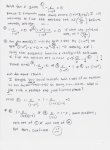
View attachment 3133
Not handy with LaTex as I think it is called. Double click the image and then double click again for a full size rendering. Thanks.
\(\displaystyle \displaystyle 1 \ - \ \frac{x}{1-x^2} \ = \ 0\) → \(\displaystyle \displaystyle x \ \ne \ \frac{\sqrt{2}}{2} \)
You are making some mistake/s, while solving through "technology".
Your algebra is better than your software.View attachment 3133
Not handy with LaTex as I think it is called. Double click the image and then double click again for a full size rendering. Thanks.
You say the software says: \(\displaystyle 1 - \dfrac{x}{1 - x^2} = 0 \implies x = \dfrac{\sqrt{2}}{2}.\) Really? Let's check.
\(\displaystyle x = \dfrac{\sqrt{2}}{2} \implies 1 - x^2 = 1 - \left(\dfrac{\sqrt{2}}{2}\right)^2 = 1 - \dfrac{2}{4} = \dfrac{1}{2} \implies\)
\(\displaystyle 1 - \dfrac{x}{1 - x^2} = 1 - \dfrac{\dfrac{\sqrt{2}}{2}}{\dfrac{1}{2}} = 1 - \dfrac{\sqrt{2}}{2} * \dfrac{2}{1} = 1 - \sqrt{2} \ne 0.\)
Your algebra is correct although maybe not as simple as required.
\(\displaystyle 1 - \dfrac{x}{1 - x^2} = 0 \implies 1 = \dfrac{x}{1 - x^2} \implies -x^2 + 1 = x \implies -x^2 - x + 1 = 0 \implies\)
\(\displaystyle x = \dfrac{-(-1) \pm \sqrt{(-1)^2 - 4(-1)(1)}}{2(- 1)}= \dfrac{1 \pm \sqrt{1 + 4}}{-2} \implies x = \dfrac{1 \pm \sqrt{5}}{-2}.\)
Now that effectively is the same answer that you got by algebra.
Rather than fiddling around with software, where you can make an error or it can make an error, learn to check your work. THAT is what will help you on a test. Substitute your final answers back into the original problem.
\(\displaystyle x = \dfrac{1 + \sqrt{5}}{-2} \implies 1 - x^2 = 1 - \left(\dfrac{1 + \sqrt{5}}{-2}\right)^2 = 1 - \dfrac{1 + 2\sqrt{5} + 5}{4} = 1 - \dfrac{3 + \sqrt{5}}{2} = \dfrac{2 - 3 - \sqrt{5}}{2} = \dfrac{-1 - \sqrt{5}}{2} = \dfrac{1 + \sqrt{5}}{- 2} \implies\)
\(\displaystyle 1 - \dfrac{x}{1 - x^2} = 1 - \dfrac{\dfrac{1 + \sqrt{5}}{-2}}{\dfrac{1 + \sqrt{5}}{-2}} = 1 - 1 = 0.\) It checks.
\(\displaystyle x = \dfrac{1 - \sqrt{5}}{-2} \implies 1 - x^2 = 1 - \left(\dfrac{1 - \sqrt{5}}{-2}\right)^2 = 1 - \dfrac{1 - 2\sqrt{5} + 5}{4} = 1 - \dfrac{3 - \sqrt{5}}{2} = \dfrac{2 - 3 + \sqrt{5}}{2} = \dfrac{-1 + \sqrt{5}}{2} = \dfrac{1 - \sqrt{5}}{- 2} \implies\)
\(\displaystyle 1 - \dfrac{x}{1 - x^2} = 1 - \dfrac{\dfrac{1 - \sqrt{5}}{-2}}{\dfrac{1 - \sqrt{5}}{-2}} = 1 - 1 = 0.\) It checks.
thanks
Thank you. I would like to say that the computer made a mistake but that is only slightly less plausible then "the dog ate my homework". I made a transcription error and solved a problem that was slightly different the problem I fed the computer. Sigh.
\(\displaystyle \displaystyle 1 \ - \ \frac{x}{1-x^2} \ = \ 0\) → \(\displaystyle \displaystyle x \ \ne \ \frac{\sqrt{2}}{2} \)
You are making some mistake/s, while solving through "technology".
Thank you. I would like to say that the computer made a mistake but that is only slightly less plausible then "the dog ate my homework". I made a transcription error and solved a problem that was slightly different the problem I fed the computer. Sigh.
Dale10101 said:I multiply both sides by \(\displaystyle \ (1 - x^2) \ \) to get
\(\displaystyle (1 - x^2) - x \ = \ 0 \ = \ -x^2 - x + 1 = 0 \ \ \) Noteing \(\displaystyle x \ne 1\)
Using the quadratic formula...
1) \(\displaystyle \ \)Use the implication symbol between those equations.
2) \(\displaystyle \ \) Not only can x not equal 1, but also x cannot equal -1, because each makes \(\displaystyle \ (1 - x^2) \ = \ 0.\)
3) \(\displaystyle \ \)If you're going to use the Quadratic Formula, then you should first multiply (or divide) each side of that equation by -1, \(\displaystyle \ \) **
\(\displaystyle \ \ \ \ \ \) to avoid ending up with a negative number in the denominator as JeffM has. You should expect that the simplified answer
\(\displaystyle \ \ \ \ \ \ \)will have a (positive) 2 in the denominator.
Instead of that answer you showed as \(\displaystyle \ \ x \ = \ \pm \dfrac{\sqrt{5}}{2} - \dfrac{1}{2}, \ \ \) the final form should be \(\displaystyle \ \ x \ = \ \dfrac{-1 \pm \sqrt{5}}{2}.\)
** \(\displaystyle \ \ -1(-x^2 - x + 1) \ = \ 0 \ \implies \ x^2 + x - 1 \ = \ 0.\)
.Do you remember being told a few times that:
if (a+b) / c = 0
then a + b = 0 .... and the "c" disappears\(\displaystyle \ \)provided \(\displaystyle \ c \ne \ 0.\)
Last edited:
gracious
Thank you for our detailed response, I have looked at it closely and note in particular that you check answers by dividing the task of evaluation into sections, denominator, then numerator, etc rather then caring everything around. That should help.
For me, if I was given the choice of adding 10 points to my IQ or having the focus to compute without silly errors it would be a tough call.
BTW. All of that writing you did of math notation, if I may ask, do you use a particular program ... keyboard? tablet with writing writing scribe? Thanks.
Your algebra is better than your software.
You say the software says: \(\displaystyle 1 - \dfrac{x}{1 - x^2} = 0 \implies x = \dfrac{\sqrt{2}}{2}.\) Really? Let's check.
\(\displaystyle x = \dfrac{\sqrt{2}}{2} \implies 1 - x^2 = 1 - \left(\dfrac{\sqrt{2}}{2}\right)^2 = 1 - \dfrac{2}{4} = \dfrac{1}{2} \implies\)
\(\displaystyle 1 - \dfrac{x}{1 - x^2} = 1 - \dfrac{\dfrac{\sqrt{2}}{2}}{\dfrac{1}{2}} = 1 - \dfrac{\sqrt{2}}{2} * \dfrac{2}{1} = 1 - \sqrt{2} \ne 0.\)
Your algebra is correct although maybe not as simple as required.
\(\displaystyle 1 - \dfrac{x}{1 - x^2} = 0 \implies 1 = \dfrac{x}{1 - x^2} \implies -x^2 + 1 = x \implies -x^2 - x + 1 = 0 \implies\)
\(\displaystyle x = \dfrac{-(-1) \pm \sqrt{(-1)^2 - 4(-1)(1)}}{2(- 1)}= \dfrac{1 \pm \sqrt{1 + 4}}{-2} \implies x = \dfrac{1 \pm \sqrt{5}}{-2}.\)
Now that effectively is the same answer that you got by algebra.
Rather than fiddling around with software, where you can make an error or it can make an error, learn to check your work. THAT is what will help you on a test. Substitute your final answers back into the original problem.
\(\displaystyle x = \dfrac{1 + \sqrt{5}}{-2} \implies 1 - x^2 = 1 - \left(\dfrac{1 + \sqrt{5}}{-2}\right)^2 = 1 - \dfrac{1 + 2\sqrt{5} + 5}{4} = 1 - \dfrac{3 + \sqrt{5}}{2} = \dfrac{2 - 3 - \sqrt{5}}{2} = \dfrac{-1 - \sqrt{5}}{2} = \dfrac{1 + \sqrt{5}}{- 2} \implies\)
\(\displaystyle 1 - \dfrac{x}{1 - x^2} = 1 - \dfrac{\dfrac{1 + \sqrt{5}}{-2}}{\dfrac{1 + \sqrt{5}}{-2}} = 1 - 1 = 0.\) It checks.
\(\displaystyle x = \dfrac{1 - \sqrt{5}}{-2} \implies 1 - x^2 = 1 - \left(\dfrac{1 - \sqrt{5}}{-2}\right)^2 = 1 - \dfrac{1 - 2\sqrt{5} + 5}{4} = 1 - \dfrac{3 - \sqrt{5}}{2} = \dfrac{2 - 3 + \sqrt{5}}{2} = \dfrac{-1 + \sqrt{5}}{2} = \dfrac{1 - \sqrt{5}}{- 2} \implies\)
\(\displaystyle 1 - \dfrac{x}{1 - x^2} = 1 - \dfrac{\dfrac{1 - \sqrt{5}}{-2}}{\dfrac{1 - \sqrt{5}}{-2}} = 1 - 1 = 0.\) It checks.
Thank you for our detailed response, I have looked at it closely and note in particular that you check answers by dividing the task of evaluation into sections, denominator, then numerator, etc rather then caring everything around. That should help.
For me, if I was given the choice of adding 10 points to my IQ or having the focus to compute without silly errors it would be a tough call.
BTW. All of that writing you did of math notation, if I may ask, do you use a particular program ... keyboard? tablet with writing writing scribe? Thanks.
um ...
Well, actually no. Maybe I was sleeping that day. I do recall the concept of cross multiplication. If a/c = d/b then ab = cd. I also have a fuzzy recollection that multiplying by zero is risky in some cases, that one should try and collect a constant on one side of an equation rather then zero.
Your short hand rule makes sense and is a good mnemonic, thanks,
Do you remember being told a few times that:
if (a+b) / c = 0
then a + b = 0 .... and the "c" disappears
Well, actually no. Maybe I was sleeping that day. I do recall the concept of cross multiplication. If a/c = d/b then ab = cd. I also have a fuzzy recollection that multiplying by zero is risky in some cases, that one should try and collect a constant on one side of an equation rather then zero.
Your short hand rule makes sense and is a good mnemonic, thanks,
Check
Item 1) Implication symbol, yes, more accurate, more readable.
Item 2) +1 and -1, obvious but unrealized, thanks.
Item 3) I see what you are saying, I like that ... and yes my answer was irregularly written,
Thank you.
1) \(\displaystyle \ \)Use the implication symbol between those equations.
2) \(\displaystyle \ \) Not only can x not equal 1, but also x cannot equal -1, because each makes \(\displaystyle \ (1 - x^2) \ = \ 0.\)
3) \(\displaystyle \ \)If you're going to use the Quadratic Formula, then you should first multiply (or divide) each side of that equation by -1, \(\displaystyle \ \) **
\(\displaystyle \ \ \ \ \ \) to avoid ending up with a negative number in the denominator as JeffM has. You should expect that the simplified answer
\(\displaystyle \ \ \ \ \ \ \)will have a (positive) 2 in the denominator.
Instead of that answer you showed as \(\displaystyle \ \ x \ = \ \pm \dfrac{\sqrt{5}}{2} - \dfrac{1}{2}, \ \ \) the final form should be \(\displaystyle \ \ x \ = \ \dfrac{-1 \pm \sqrt{5}}{2}.\)
** \(\displaystyle \ \ -1(-x^2 - x + 1) \ = \ 0 \ \implies \ x^2 + x - 1 \ = \ 0.\)
.
Item 1) Implication symbol, yes, more accurate, more readable.
Item 2) +1 and -1, obvious but unrealized, thanks.
Item 3) I see what you are saying, I like that ... and yes my answer was irregularly written,
Thank you.
This site supports LaTeX, which is a software program that renders math symbolism.BTW. All of that writing you did of math notation, if I may ask, do you use a particular program ... keyboard? tablet with writing writing scribe? Thanks.
It is not overly difficult to learn LaTeX; you can see how it is done by hitting reply with quote to a post with math symbolism and looking at the copy of the quoted post in the window where you write your response. However, I do not advocate students learning LaTeX for two reasons. It just gives you another thing to learn in addition of the primary topic you are studying, and it can be very fussy. It at least doubles, perhaps triples, the time it takes me to generate a post. Nevertheless, I use it because I think it makes it somewhat easier for students to follow what I am trying to say.
As for breaking involved computations into pieces, I have found that carrying a bunch of numbers around greatly increases the probability that I shall make a copying mistake.
Yes
I see. You are right I do not need another thing to learn at the moment. Thanks for the info.
This site supports LaTeX, which is a software program that renders math symbolism.
It is not overly difficult to learn LaTeX; you can see how it is done by hitting reply with quote to a post with math symbolism and looking at the copy of the quoted post in the window where you write your response. However, I do not advocate students learning LaTeX for two reasons. It just gives you another thing to learn in addition of the primary topic you are studying, and it can be very fussy. It at least doubles, perhaps triples, the time it takes me to generate a post. Nevertheless, I use it because I think it makes it somewhat easier for students to follow what I am trying to say.
As for breaking involved computations into pieces, I have found that carrying a bunch of numbers around greatly increases the probability that I shall make a copying mistake.
I see. You are right I do not need another thing to learn at the moment. Thanks for the info.