Solving equation for 'y'

jonnburton

Junior Member
Joined
Dec 16, 2012
Messages
155
I've been trying to solve this equation for 'y' for a good while now, to absolutely no avail. I can't see for the life of me how it's done. It's part of the explanation in my book on differential equations.

\(\displaystyle \frac{y}{1-(y/K)}=Ce^{rt}\)

To satisfy initial condition \(\displaystyle y(0)=y_0\) we must put \(\displaystyle C=\frac{y_0}{1-(y_0/K)}\)


This next step is the one that that I can't figure out:

Solving for y, we obtain

\(\displaystyle y = \frac{y_0K}{y_0+(K-y_0)e^{-rt}}\)

Is anyone able to show me how they did this step, because whatever I do I can't manage to isolate 'y' on one side?
 
Thanks a lot for going through that Denis. I will study it carefully several times. Sometimes I do find these algebraic manipulations very troublesome!

I am not sure what the Ce^rt actually represents. In this case the equation refers to population dynamics and in the process of getting a complete solution to the equation, an expression for C had to be obtained from the initial conditions.

I take your point about the bank interest compounding frequency though!
 
Thanks for the advice and help Denis. With a bit of practice I'll get through these with less trouble!
 
I've been trying to solve this equation for 'y' for a good while now, to absolutely no avail. I can't see for the life of me how it's done. It's part of the explanation in my book on differential equations.

\(\displaystyle \frac{y}{1-(y/K)}=Ce^{rt}\)

To satisfy initial condition \(\displaystyle y(0)=y_0\) we must put \(\displaystyle C=\frac{y_0}{1-(y_0/K)}\)


This next step is the one that that I can't figure out:

Solving for y, we obtain

\(\displaystyle y = \frac{y_0K}{y_0+(K-y_0)e^{-rt}}\)

Is anyone able to show me how they did this step, because whatever I do I can't manage to isolate 'y' on one side?

\(\displaystyle \frac{y}{1-(y/K)}=Ce^{rt}\)

\(\displaystyle \dfrac{1- \frac{y}{K}}{y} \ = \ \dfrac{1}{C} e^{-rt}\)

\(\displaystyle \dfrac{1}{y} - \dfrac{1}{K} \ = \ \dfrac{1-\frac{y_0}{K}}{y_0}e^{-rt}\)

\(\displaystyle \dfrac{1}{y} - \dfrac{1}{K} \ = \ \dfrac{e^{-rt}*(K - y_0)}{K*y_0}\)

and continue....
 
Oh the pain

I've been trying to solve this equation for 'y' for a good while now, to absolutely no avail. I can't see for the life of me how it's done. It's part of the explanation in my book on differential equations.

\(\displaystyle \frac{y}{1-(y/K)}=Ce^{rt}\)

To satisfy initial condition \(\displaystyle y(0)=y_0\) we must put \(\displaystyle C=\frac{y_0}{1-(y_0/K)}\)


This next step is the one that that I can't figure out:

Solving for y, we obtain

\(\displaystyle y = \frac{y_0K}{y_0+(K-y_0)e^{-rt}}\)

Is anyone able to show me how they did this step, because whatever I do I can't manage to isolate 'y' on one side?
I submit my personal notes on this problem for whatever value you might further find in thinking about algebraic manipulations.

Algebra, you gotta love it, and hate it … I mean the pleasure of its power in finding answers to questions that would take even a clever person months to sus out versus the trudge of drudgery in treading the symbolic path which in a moments lapse of attention (1 + 1 = 3, etc) sends you into an abyss which might days hours to climb out of, or worse yet, send you running off to law school.

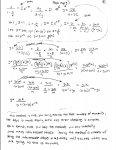
Page 1. The direct route taken by M. Denis but, unfortunately, calculated by me before finding his labor saving devices of substitution. Devices which I took to heart on pages 3 and 4.

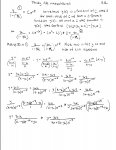
Page 2. Is the route taken by M. Subhotosh Khan completed. Particularly important is the realization that y is already isolated on the left side of the equation and the use of inversion to make it available for factoring … very cool.

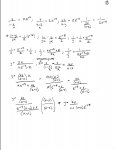
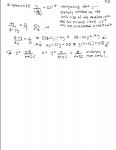
Pages 3 and 4 are an experiment in simplification by extensive use of substitution and a method that proved to have some real benefits.

2014_0310.Jpg2014_0310(2).Jpg2014_0310(3).Jpg2014_0310(4).Jpg
 
I see there are a number of ways to approach this. It would pay to go through each of them carefully. Much as I'd like to escape it, algebra's always going to be there!
 
I submit my personal notes on this problem for whatever value you might further find in thinking about algebraic manipulations.

Algebra, you gotta love it, and hate it … I mean the pleasure of its power in finding answers to questions that would take even a clever person months to sus out versus the trudge of drudgery in treading the symbolic path which in a moments lapse of attention (1 + 1 = 3, etc) sends you into an abyss which might days hours to climb out of, or worse yet, send you running off to law school.

Page 1. The direct route taken by M. Denis but, unfortunately, calculated by me before finding his labor saving devices of substitution. Devices which I took to heart on pages 3 and 4.

Page 2. Is the route taken by M. Subhotosh Khan completed. Particularly important is the realization that y is already isolated on the left side of the equation and the use of inversion to make it available for factoring … very cool.

Pages 3 and 4 are an experiment in simplification by extensive use of substitution and a method that proved to have some real benefits.

View attachment 3890View attachment 3891View attachment 3892View attachment 3893

On page 3 - the last line is incorrect.
 
Right

On page 3 - the last line is incorrect.

The second expression for y is not correct. This is easily seen by factoring out (1/a+cd) from the second expression. Hey, I did say "which is most useful" (maybe I should go to law school), but yes I goofed. Thanks for looking over the work.
 
Top