jonnburton
Junior Member
- Joined
- Dec 16, 2012
- Messages
- 155
I've been trying to solve this equation for 'y' for a good while now, to absolutely no avail. I can't see for the life of me how it's done. It's part of the explanation in my book on differential equations.
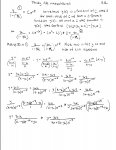
\(\displaystyle \frac{y}{1-(y/K)}=Ce^{rt}\)
To satisfy initial condition \(\displaystyle y(0)=y_0\) we must put \(\displaystyle C=\frac{y_0}{1-(y_0/K)}\)
This next step is the one that that I can't figure out:
Solving for y, we obtain
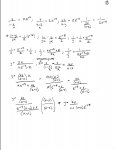
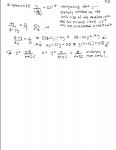
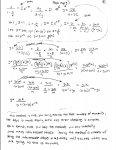
\(\displaystyle y = \frac{y_0K}{y_0+(K-y_0)e^{-rt}}\)
Is anyone able to show me how they did this step, because whatever I do I can't manage to isolate 'y' on one side?
\(\displaystyle \frac{y}{1-(y/K)}=Ce^{rt}\)
To satisfy initial condition \(\displaystyle y(0)=y_0\) we must put \(\displaystyle C=\frac{y_0}{1-(y_0/K)}\)
This next step is the one that that I can't figure out:
Solving for y, we obtain
\(\displaystyle y = \frac{y_0K}{y_0+(K-y_0)e^{-rt}}\)
Is anyone able to show me how they did this step, because whatever I do I can't manage to isolate 'y' on one side?