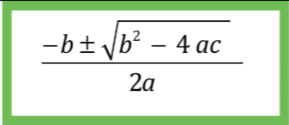
Struggling with The Quadratic Formula excercises.

King Friday

New member
Joined
May 25, 2026
Messages
18
I'm having a hard time with Problem 3. (I just went from Problem 1 to Problem 3 since I don't think it makes a difference and indexing isn't this teachers strong point. English reads from Left to Right last time I checked. lol
For a little more info, on Problem 1, I realized I wasn't reducing the square root of 9. I got that right after fixing that issue. ( see image 1) I include it since it may shed light on my error(s) in Problem 3.
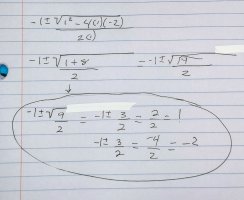
Udemy Quadratic Formula Problems 1.jpg
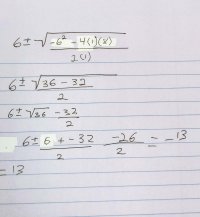
The second image shows Problem 3, which I've worked several times and come up wrong, according to the provided answers, {2,4} I'm WAY off. Udemy Quadratic Formula Problems 2.jpgI didn't go any further here since the -13 is seriously wrong.
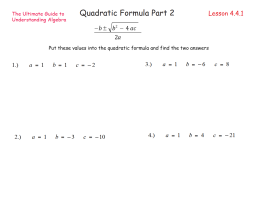
 

Attachments

  • Screenshot Udemy Excecises.png
    Screenshot Udemy Excecises.png
    85.6 KB · Views: 4
The first thing you need to do is read the quadratric formula correctly.

Correct is [imath]\dfrac{-b \pm \sqrt{b^2-4ac}}{2a}[/imath]

What you are saying and using is [imath]-b \pm \dfrac{\sqrt{b^2-4ac}}{2a}[/imath] which is incorrect.

Do you see the difference? The fraction bar should extend from the [imath]-b[/imath] to the end of the radical. You are only putting the fraction bar under the radical. Your second image contains a number of basic arithmetic mistakes.

Here is your second image corrected: [imath]\dfrac{-(-6) \pm \sqrt{(-6)^2-4 \cdot 1 \cdot 8}}{2 \cdot 1} = \dfrac{6 \pm \sqrt{36-32}}{2}=\dfrac{6 \pm \sqrt{4}}{2}=\dfrac{6 \pm 2}{2}=3 \pm 1= 4 \text{ or }2[/imath]
 
For the first part, the answer is correct, but it looks like you wrote the expression incorrectly. You are solving [math]x^2+x-2=0[/math]Applying the quadratic formula gives
[math]x=\frac{-1\pm\sqrt{1^2-4(1)(-2)}}{2}=\frac{-1\pm\sqrt{9}}{2}=\frac{-1\pm 3}{2}[/math] which gives
[math]x_1=1, \quad x_2=-2[/math]But you forgot that [imath]-1[/imath] is also divided by [imath]2[/imath] in the quadratic formula, and so, interpreting your writing literally, you wrote
[math]x=-1\pm\frac{\sqrt{1^2-4(1)(-2)}}{2}=-1\pm\frac{\sqrt9}{2}=-1\pm\frac{3}{2}[/math]This gives the roots
[math]x_1=\frac{1}{2}, \quad x_2=-\frac{5}{2}[/math]which are the solutions to the equation [math]x^2+2x-\frac{5}{4}=0[/math]
For problem 3, you are solving [imath]x^2-6x+8=0[/imath]. Here, you made the same mistake again, forgetting that the whole expression is divided by 2, the solution should begin with

[math]x=\frac{6\pm\sqrt{6^2-4(1)(8)}}{2}=\frac{6\pm\sqrt{36-32}}{2}[/math] Your next error occurs on the third line, you wrote [math]\frac{\sqrt{36-32}}{2}=\sqrt{36}-\frac{32}{2}[/math] But this is not allowed! The mistake is treating the square root as if it distributes over subtraction and division, which it does not. The correct approach is
[math]\frac{\sqrt{36-32}}{2}=\frac{\sqrt{4}}{2}=\frac{2}{2}=1[/math]
The square root function is not linear. In general,
[math]\sqrt{a-b}\neq \sqrt{a}-\sqrt{b}[/math]And certainly not [math]\sqrt{a-b}\neq \sqrt{a}-b[/math]
Even if we temporarily ignored the square-root mistake, there is a second algebraic error involving the fraction.
Starting from [math]\frac{\sqrt{36-32}}{2}[/math]The denominator 2 divides the entire numerator [imath]\sqrt{36-32}[/imath], if someone wanted to split the fraction the correct rule would be [math]\frac{A-B}{2}=\frac{A}{2}-\frac{B}{2}[/math]So if one (incorrectly) replaced [imath]\sqrt{36-32}[/imath] by [imath]\sqrt{36}-32[/imath], then the next step should be [math]\frac{\sqrt{36}-32}{2}=\frac{\sqrt{36}}{2}-\frac{32}{2}[/math]Not [math]\sqrt{36}-\frac{32}{2}[/math]
 
Last edited:
Thank you SO much. I'm an idiot. lol:D
All of this falls under the category, "Things I should have learned in school had I been paying attention."
I'm 68 years old. :oops:
 
Last edited:
Thank you SO much. I'm an idiot. lol:D
All of this falls under the category, "Things I should have learned in school had I been paying attention."
I'm 68 years old. :oops:
No worries. As a side remark: in all of these problems the coefficient of [imath]x^2[/imath] is 1, so the equations are already in the form [imath]x^2+px+q=0[/imath]. In that case, completing the square gives
[math]x=-\frac{p}{2}\pm \sqrt{\left(\frac{p}{2}\right)^2-q}{}[/math]which can be a more direct way to solve them, and some may find it easier to remember than the standard quadratic formula.

In Sweden this is known as the “[imath]p[/imath]–[imath]q[/imath] formula”. More generally, any quadratic equation [imath]ax^2+bx+c=0[/imath] can be transformed into this form by dividing the entire equation by [imath]a[/imath] (the coefficient of [imath]x^2[/imath]) provided [imath]a\neq0[/imath].
 
No worries. As a side remark: in all of these problems the coefficient of [imath]x^2[/imath] is 1, so the equations are already in the form [imath]x^2+px+q=0[/imath]. In that case, completing the square gives
[math]x=-\frac{p}{2}\pm \sqrt{\left(\frac{p}{2}\right)^2-q}{}[/math]which can be a more direct way to solve them, and some may find it easier to remember than the standard quadratic formula.

In Sweden this is known as the “[imath]p[/imath]–[imath]q[/imath] formula”. More generally, any quadratic equation [imath]ax^2+bx+c=0[/imath] can be transformed into this form by dividing the entire equation by [imath]a[/imath] (the coefficient of [imath]x^2[/imath]) provided [imath]a\neq0[/imath].
That's nice and you grew up doing it that way! So much to learn from other cultures.
I've been hammering away at the Screenshot 2026-05-31 085946.png for the last few days so It's starting to be internalized.
 
Thank you SO much. I'm an idiot. lol:D
All of this falls under the category, "Things I should have learned in school had I been paying attention."
I'm 68 years old. :oops:
Being an idiot is a recurring experience in all my studies :)
 
the solution should begin with

[math]x=\frac{6\pm\sqrt{6^2-4(1)(8)}}{2} [/math]

No, similar to the expression of post #2 of mrtwhs, it would begin with

[math]x \ = \ \frac{-(-6) \ \pm \sqrt{(-6)^2 \ - \ 4(1)(8)}}{2(1)} [/math]
The b-value is -6, and it is shown being negated and squared. All values
for a, b, and c, respectively, are shown being substituted. They are done
so consistently with parentheses.
 
No, similar to the expression of post #2 of mrtwhs, it would begin with

[math]x \ = \ \frac{-(-6) \ \pm \sqrt{(-6)^2 \ - \ 4(1)(8)}}{2(1)} [/math]
The b-value is -6, and it is shown being negated and squared. All values
for a, b, and c, respectively, are shown being substituted. They are done
so consistently with parentheses.
Fair point. When teaching the quadratic formula, it is good practice to write the substitutions as [imath]-(−6)[/imath] and [imath](-6)^2[/imath]. I was focusing on the subsequent algebraic mistake, and I tend not to write out those intermediate substitutions anymore, since I mentally simplify them immediately.
 
Top