
You are using an out of date browser. It may not display this or other websites correctly.
You should upgrade or use an alternative browser.
You should upgrade or use an alternative browser.
SURFACE AREA OF COMPOSITE SOLID.
- Thread starter madiiiiss
- Start date

The Highlander
Senior Member
- Joined
- Feb 18, 2022
- Messages
- 1,231
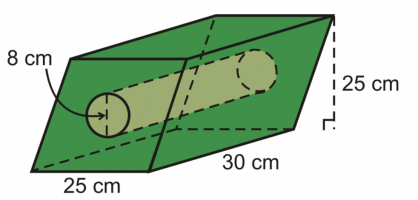
Hi madiiiiss,View attachment 31426Hi! I need help to work out the surface area of this composite solid. The cylinder is open meaning it is hollow in the middle. What is a simple way to work this out?
Your cylinder looks just like the cardboard centre of a kitchen roll once all the sheets have been used. What would you get if you cut straight up the side and flattened it out?
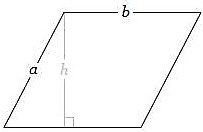
The attached picture may also help you with the rest.
Show us how you attempt to answer the problem now and we will offer further help if needed.
Attachments
D
Deleted member 4993
Guest
Is that toroidal hole inside a right prismatic box with rhombus as two side-faces ?View attachment 31426Hi! I need help to work out the surface area of this composite solid. The cylinder is open meaning it is hollow in the middle. What is a simple way to work this out?
The Highlander
Senior Member
- Joined
- Feb 18, 2022
- Messages
- 1,231
It looks to me like the ends are parallelograms and the four sides rectangular?Is that toroidal hole inside a right prismatic box with rhombus as two side-faces ?
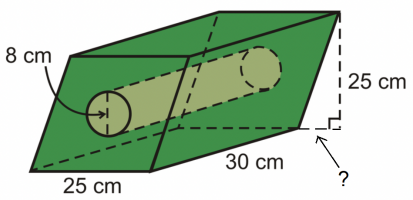
But I wonder if the dimension indicated below may have been supplied in the original?
Attachments
scottbrandon
Junior Member
- Joined
- Feb 18, 2024
- Messages
- 55
The surface area of a hollow cylinder that is open at the top is calculated by adding the outer curved surface, the inner curved surface, and the bottom. Mathematically, it is expressed as 2 𝜋 𝑟 outer ℎ + 2 𝜋 𝑟 inner ℎ + 𝜋 ( 𝑟 outer 2 − 𝑟 inner 2 ) 2πr outer h+2πr inner h+π(r outer 2 −r inner 2 ). This formula accounts for the entire exposed surface area of the cylinder, including both the inside and outside walls as well as the base. You just need to substitute the outer radius, inner radius, and height of your cylinder to find the total surface area.Hi madiiiiss,
Your cylinder looks just like the cardboard centre of a kitchen roll once all the sheets have been used. What would you get if you cut straight up the side and flattened it out?
The attached picture may also help you with the rest.
Show us how you attempt to answer the problem using solid surface sheets now and we will offer further help if needed.
The surface area of a hollow cylinder that is open at the top is calculated by adding the outer curved surface, the inner curved surface, and the bottom. Mathematically, it is expressed as 2 𝜋 𝑟 outer ℎ + 2 𝜋 𝑟 inner ℎ + 𝜋 ( 𝑟 outer 2 − 𝑟 inner 2 ) 2πr outer h+2πr inner h+π(r outer 2 −r inner 2 ). This formula accounts for the entire exposed surface area of the cylinder, including both the inside and outside walls as well as the base. You just need to substitute the outer radius, inner radius, and height of your cylinder to find the total surface area.
This is the second post that you have made recently to a second subforum thread that was left from four years ago.
Please only respond to recent threads to potentially help the original poster and/or start your own thread.

Dr.Peterson
Elite Member
- Joined
- Nov 12, 2017
- Messages
- 16,960
More important, the answer isn't relevant to the actual question; there is no"outer curved surface", because it is not a "hollow [circular] cylinder"!
The correct answer is just, "Add up the areas of the various surfaces"; and the comment about a missing dimension is relevant.
If you're going to answer old questions that no one is interested in, at least answer them correctly.
The correct answer is just, "Add up the areas of the various surfaces"; and the comment about a missing dimension is relevant.
If you're going to answer old questions that no one is interested in, at least answer them correctly.