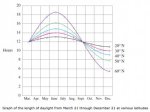
The city of New Orleans is located at latitude 30°N. Use the figure below to find a function that models the number of hours of daylight at New Orleans as a function of the time of year. To check the accuracy of your model, use the fact that on March 31 (
t = 90) the sun rises at 5:51 AM and sets at 6:18 PM in New Orleans.
Function: L(t)=
As an example, let's restrict our discussion for the 60\(\displaystyle ^\circ\)N curve.
First, you are expected to measure time in days [see the t=90 for March 31st]. Next this looks like a periodic function. That is each individual function is the same each year starting at equal day and night hours on March 21st [assuming they are using the usual approximate time of the spring equinox]. Then, skipping leap years, L(t+365)=L(t). From the graph, L(t) looks like an offset sine function. The amplitude is 6.5 [from a midpoint of 12 to a maximum of about 18.5], the offset is 12 [from the 12 midpoint], and the period is 365. So, arbitrarily starting the daytime [sunrise] period at 6am on March 21 [t=80.25] with longer hours of daylight being earlier and the time being split evenly on the am and pm side, we will take
L(t) = 12 + 6.5 sin(\(\displaystyle \frac{2\, \pi\, (t\, -\, 80.25)}{365}\))
We then have sunrise SR (hours in 24 hour clock notation)
SR(t) = 6 - 0.5 [L(t) - 12] = 6 - 3.25 sin(\(\displaystyle \frac{2\, \pi\, (t\, -\, 80.25)}{365}\))
and sunset SS as
SS(t) = 18 + 0.5 [L(t) - 12] = 18 + 3.25 sin(\(\displaystyle \frac{2\, \pi\, (t\, -\, 80.25)}{365}\))
Using the summer solstice of approximately June 21 (t=172) as the minimum sun rise and maximum sunset times we get
SR(172) ~ 6 - 3.25 sin(0.50274 \(\displaystyle \pi\)) ~ 2.75 = 2:45 am
SS(172) ~21.25 = 9:15 pm
which agrees pretty well with the graph, i.e. daylight hours of about 18.5 hours.
For the winter solstice of about Dec 21 [t=355] we have
SR(355) ~ 6 - 3.25 sin(1.50548 \(\displaystyle \pi\)) ~ 9.25 = 9:15 am
SS(172) ~14.75 = 14:55 pm
or about 5.5 hours of daylight which agrees pretty well with the graph.