This inverse question is driving me crazy!

PaigeLawrence

New member
Joined
Sep 28, 2012
Messages
3
Hi there,

There is a question on my assignment that states: If g(x)=8+x+e^8 find g^-1(9)

I've been trying to solve this for almost an hour and keep getting stuck. I've tried switching x and y then solving for y but I always get stuck dealing with the natural log (e). I've also tried solving for x and then switching but it doesn't seem to be working. If anyone could help with this that would be awesome!

Thanks so much!
 
If \(\displaystyle h(x) = 8 + x\), how would you find \(\displaystyle h^{-1}(9)\)

Is \(\displaystyle e^{8}\) written correctly? Is it just a number?
 
Next time, please show your work up to the point where you get stuck.

The variable x does not appear in any exponent, so there's no need to take natural logs.

g(x) = x + e^8 + 8

In other words, function g simply adds the number e^8+8 to x (roughly x+2989).

Because g is obtained by adding 8+e^8, the inverse is obtained by subtracting 8+e^8. :cool:
 
Last edited:
sorry, typo

Thanks for answering, so sorry but that was a typo, I swear I proof read and previewed that post! It's g(x) = 8+x+e^X
 
Thanks for answering, so sorry but that was a typo, I swear I proof read and previewed that post! It's g(x) = 8+x+e^X

Keep the same case of leters for the variables.


For example, use either lower the case, "x," or the upper case "X," throughout the problem
to represent the same variable.
 
Thanks

Thanks for all the help. It is an online assignment so I took a guess at zero and it was right. I'll ask my prof about the specifics/understanding on Monday. You guys are great!
 
[e^8 is] a typo

It's g(x) = 8 + x + e^x

Gosh. I think that the inverse function for g(x) involves something called the LambertW function. (Perhaps, your materials are wrong, or you've misunderstood the instructions?)

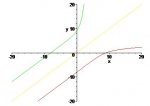
I suppose that you could solve this by graphing g(x), and then using symmetry about the line y=x to graph the inverse function of g(x) -- if you're precise enough with your graphing -- thus finding the answer without knowing an algebraic expression for function g's inverse.

y=g(x) is green
y=g-1(x) is red
y=x is yellow.

gee and gee inverse.JPG

Otherwise, I don't know what's going on.


Don't swear :cool:
 
Last edited:
Okay -- I just realized another way to reason it out in the absence of algebraic expressions or graphing, by resorting to definitions and properties of inverse functions.

When thinking about the behavior of g(x), that is, when thinking about the shape of function g's graph, we would mentally calculate the y-intercept (0,9).

We would also realize that functions with inverses are one-to-one (and so are the inverse functions themselves).

Well, the inverse function's x-intercept corresponds to function g's y-intercept, yes?

In other words, if g(x) has y-intercept at coordinates (a,b), then the inverse function has x-intercept at coordinates (b,a).

Because the inverse function is one-to-one, it can have only one x-intercept: (9,0).

Hence, we realize that the inverse's output must be zero when its input is 9.
 
Last edited:
Top