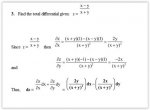
M Mechaman New member Joined Feb 7, 2015 Messages 14 Feb 22, 2015 #1 Here's the problem. Not sure how the first partial dif z/x is set up. why does it become (x+y)(1) - (x-y)(1) / (x+y)^2 Is there a chain rule or product rule being used?
Here's the problem. Not sure how the first partial dif z/x is set up. why does it become (x+y)(1) - (x-y)(1) / (x+y)^2 Is there a chain rule or product rule being used?
D Deleted member 4993 Guest Feb 22, 2015 #2 Mechaman said: Here's the problem. Not sure how the first partial dif z/x is set up. why does it become (x+y)(1) - (x-y)(1) / (x+y)^2 Is there a chain rule or product rule being used? View attachment 4997 Click to expand... While calculating \(\displaystyle \displaystyle{\frac{\partial z}{\partial x}}\) - y is held constant and then the quotient rule is applied. Similarly, while calculating \(\displaystyle \displaystyle{\frac{\partial z}{\partial y}}\) - x is held constant and then the quotient rule is applied.
Mechaman said: Here's the problem. Not sure how the first partial dif z/x is set up. why does it become (x+y)(1) - (x-y)(1) / (x+y)^2 Is there a chain rule or product rule being used? View attachment 4997 Click to expand... While calculating \(\displaystyle \displaystyle{\frac{\partial z}{\partial x}}\) - y is held constant and then the quotient rule is applied. Similarly, while calculating \(\displaystyle \displaystyle{\frac{\partial z}{\partial y}}\) - x is held constant and then the quotient rule is applied.