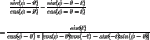
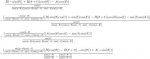
Use ksdhart's simplification and simplify a bit further:
Numerator:
N = \(\displaystyle cos\left(\phi -\theta \right)\, cos\left(\phi -\theta -t\right)\, [R\, cos\left(\theta +t\right)\, +\, (\, R\left(\theta +t\right)\, -\, A)\, sin\left(\theta +t\right)]\)
Denominator:
D = \(\displaystyle sin\left(t\right)\)
Now take the individual limits as t goes to zero:
N \(\displaystyle \to\, cos^2\left(\phi -\theta \right)\, [R\, cos\left(\theta\right)\, +\, \left(R\, \theta\, -\, A\right)\, sin\left(\theta\right)]\)
D \(\displaystyle \to\) 0.
So, unless there is something in the relationships between the other items [R, A, \(\displaystyle \theta\) and \(\displaystyle \phi\)] the limit is infinity.