Variance of a discrete random variable

dukeham

New member
Joined
Apr 13, 2019
Messages
6
123123123.png
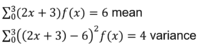
I know how to solve this problem if there was only the probability distribution table. In this case the expected value would be 1.5, the variance 1 and the standard deviation 1. But in this exercise I don't know what to do with the function g(x) =2x+3, so any help you can give me is appreciated.
 
I'm not sure what to do with that formula, but I did the exercise with this:
sum.PNG
Are these results correct or do I have to do something else?
 
First find the mean and variance of [MATH]X[/MATH]
[MATH]E[X] = 0 \cdot \dfrac 1 4 + 1 \cdot \dfrac 1 8 + 2 \cdot \dfrac 1 2 + 3 \cdot \dfrac 1 8 = \dfrac 3 2\\ Var[X] = 0^2 \cdot \dfrac 1 4 + 1^2 \cdot \dfrac 1 8 + 2^2 \cdot \dfrac 1 2 + 3^2 \cdot \dfrac 1 8 - \left(\dfrac 3 2 \right)^2 = 1[/MATH]
Then

[MATH]E[2X+3] = 2E[X] + 3 = 6\\ Var[2X+3] = 2^2 Var[X] = 4[/MATH]
While your method is valid it missed the point of the problem which Harry_the_cat tried to convey to you.
 
  • Like
Reactions: pka
Thank you both for the answers.
About the first method var(aX+b), it refers to any function that has that kind of structure? for example g(x)= 9x+3 would be: 9^2Var[X]= 81 ?
 
Thank you both for the answers.
About the first method var(aX+b), it refers to any function that has that kind of structure? for example g(x)= 9x+3 would be: 9^2Var[X]= 81 ?

any affine function, i.e. aX+b, yes.
 
Top