Velocity/Acceleration problem and horizontal tangent of a trigonometric function

jonguy

New member
Joined
Jul 18, 2015
Messages
5
I've been struggling with these problems for a long time now and know why my answers aren't good.

The first problem is a velocity problem where:
s = sin(5*pi*t)

I have found that the function of the velocity is:
v = 5*pi*cos(5*pi*t)

And the function of the acceleration is:
a = -25pi^2 * sin(5pi*t)

which are both the correct answers according to webwork. However, there is a question asking me to find the acceleration at t = 1. Seeing as how sin(5*pi*1) = 0, I got the answer a = 0. But according to webwork, this is not the correct answer. How do you find the acceleration then?

The second problem is one where I have to find the points on the graph of horizontal tangents of a trigonometric function within the interval [0,2pi].

The function in question is:
y = (cosx) / ((sqrt3) + sinx)

after differentiation and simplification, I got:
y'= (-sqrt3 * sinx - 1) / (sinx + sqrt3)^2


And found that
sinx = 1/sqrt3

so:
x = (pi + asin(1/sqrt3))
x = (2pi-asin(1/sqrt3) )

Although this isn't the correct answer.

If someone can show me what I did wrong I would greatly appreciate it.
Thank you.
-Jonathan
 
I've been struggling with these problems for a long time now and [I don't] know why my answers aren't good.

The first problem is a velocity problem where:
s = sin(5*pi*t)

I have found that the function of the velocity is:
v = 5*pi*cos(5*pi*t)

And the function of the acceleration is:
a = -25pi^2 * sin(5pi*t)

which are both the correct answers according to webwork. However, there is a question asking me to find the acceleration at t = 1. Seeing as how sin(5*pi*1) = 0, I got the answer a = 0. But according to webwork, this is not the correct answer.
The sine function is zero at every integer multiple of \(\displaystyle \, \pi\), so your answer is correct. You can verify here

My guess is that there's a problem with the software, unless there's maybe a problem with interpreting the exercise statement...? Please reply with the full and exact text of the exercise and the complete instructions, so we can verify that you're right (or find where the exercise statement was confusing or misleading). Thank you! ;)
 
I've been struggling with these problems for a long time now and know why my answers aren't good.

The first problem is a velocity problem where:
s = sin(5*pi*t)

I have found that the function of the velocity is:
v = 5*pi*cos(5*pi*t)

And the function of the acceleration is:
a = -25pi^2 * sin(5pi*t)

which are both the correct answers according to webwork. However, there is a question asking me to find the acceleration at t = 1. Seeing as how sin(5*pi*1) = 0, I got the answer a = 0. But according to webwork, this is not the correct answer. How do you find the acceleration then?

The second problem is one where I have to find the points on the graph of horizontal tangents of a trigonometric function within the interval [0,2pi].

The function in question is:
y = (cosx) / ((sqrt3) + sinx)

after differentiation and simplification, I got:
y'= (-sqrt3 * sinx - 1) / (sinx + sqrt3)^2


And found that
sinx = 1/sqrt3

so:
x = (pi + asin(1/sqrt3))
x = (2pi-asin(1/sqrt3) )

Although this isn't the correct answer.

If someone can show me what I did wrong I would greatly appreciate it.
Thank you.
-Jonathan

For your first question, unless I'm missing something, you answer of a=0 is correct.

For the second question, you seem to have lost a minus sign:
-sqrt3 * sinx - 1 = 0
is the same as
sinx = -1/sqrt3
 
The sine function is zero at every integer multiple of \(\displaystyle \, \pi\), so your answer is correct. You can verify here

My guess is that there's a problem with the software, unless there's maybe a problem with interpreting the exercise statement...? Please reply with the full and exact text of the exercise and the complete instructions, so we can verify that you're right (or find where the exercise statement was confusing or misleading). Thank you! ;)

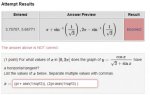
Sorry about that, here it is:

attachment.php

And thanks for the reply!:D
 

Attachments

  • Capture.PNG
    Capture.PNG
    14.8 KB · Views: 1
  • Capture.jpg
    Capture.jpg
    23.5 KB · Views: 11
Sorry about that, here it is:

attachment.php

And thanks for the reply!:D
Is this a different exercise? Because \(\displaystyle \, y\, =\, \dfrac{\cos(x)}{\sqrt{3\,}\, +\, \sin(x)}\,\) does not match what you'd posted earlier.
 
Is this a different exercise? Because \(\displaystyle \, y\, =\, \dfrac{\cos(x)}{\sqrt{3\,}\, +\, \sin(x)}\,\) does not match what you'd posted earlier.

It is the same exercise, the one I mention in the second half of my post where I wrote
The second problem is one where I have to find the points on the graph of horizontal tangents of a trigonometric function within the interval [0,2pi].

The function in question is:
y = (cosx) / ((sqrt3) + sinx)

after differentiation and simplification, I got:
y'= (-sqrt3 * sinx - 1) / (sinx + sqrt3)^2


And found that
sinx = 1/sqrt3

so:
x = (pi + asin(1/sqrt3))
x = (2pi-asin(1/sqrt3) )

Although this isn't the correct answer.

didnt know we could use LaTex Math notation here and yes \(\displaystyle \, y\, =\, \dfrac{\cos(x)}{\sqrt{3\,}\, +\, \sin(x)}\,\) is indeed what I meant with y = (cosx) / ((sqrt3) + sinx)
 
Is this a different exercise? Because \(\displaystyle \, y\, =\, \dfrac{\cos(x)}{\sqrt{3\,}\, +\, \sin(x)}\,\) does not match what you'd posted earlier.

The question was: For the function
\(\displaystyle \, y\, =\, \dfrac{\cos(x)}{\sqrt{3\,}\, +\, \sin(x)}\,\)
what are the horizontal tangents in [0,2\(\displaystyle \pi\)].

That is equivelant to the question: What are the zeros of the function
y'(x) = - [ 1 + \(\displaystyle \sqrt{3}\) sin(x) ]
in [0,2\(\displaystyle \pi\)].

As indicated above, the student has dropped a minus sign in converting to
sin(x) = -\(\displaystyle \frac{1}{\sqrt{3}}\)
and instead solved the problem: For the function
\(\displaystyle \, y\, =\, \dfrac{\cos(x)}{\sqrt{3\,}\, -\, \sin(x)}\,\)
what are the horizontal tangents in [0,2\(\displaystyle \pi\)].
 
Is this a different exercise? Because \(\displaystyle \, y\, =\, \dfrac{\cos(x)}{\sqrt{3\,}\, +\, \sin(x)}\,\) does not match what you'd posted earlier.
Sorry! I just realized I had misinterpreted your question! :(
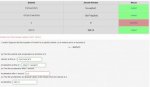
Here is the question for the velocity problem if it helps solve the issue! Thank you for your help.:)
attachment.php
 

Attachments

  • Capture2.jpg
    Capture2.jpg
    19 KB · Views: 13
Sorry! I just realized I had misinterpreted your question! :(
Here is the question for the velocity problem if it helps solve the issue! Thank you for your help.:)
attachment.php
I'm sorry, but this image is too small for me to be able to read. Please reply with the typed-out text of the exercise. Thank you.
 
Top