Volume of a Torus.

sepoto

New member
Joined
Sep 19, 2013
Messages
16
4c1q.jpg4c1a.jpg

In regards to the equation of the torus \(\displaystyle (x-b)^2+y^2 \lneq a^2\) the first thing I notice is that Wolfram Alpha has a different equation for the torus.

http://www.wolframalpha.com/input/?i=torus+graph
\(\displaystyle (c-\sqrt{x^2+y^2})^2+z^2 = a^2\)

I tried to come up with a way to graph the torus in my graphing program "Graph" but I think its either a little too complex for my program or I just have not figured out how to graph it yet.

I think it would help if I knew what the purpose of the variables "a" and "b" are for in the equation.

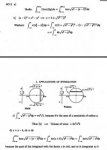
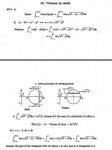
So I am trying part a) of the exercise and the solutions manual says the first step to setting up an integral for a volume is:

\(\displaystyle \int^{b+a}_{b-a} 2\pi x*2y\;dx\)

I don't understand how the integral above was derived. So far I have done the exercises for the disc method but those are much easier than this one.

Thank you in advance for any help on this problem...
 
Capture.jpg

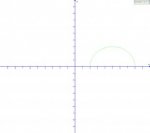
I believe the semicircle is offset a distance "b" from the origin 0,0 where the radius a is some number less than b. The graph is actually of a semicircle:

Graph.jpg
The rest in the solutions manual I found to fall into place once this is established.
 
Yes, (0,b) is the center of the circular cross section for the half plane \(\displaystyle x\ge 0\), and a is the radius of the circle. Then (b-a,0) is the left-most point of the circular cross section and (b+a,0) is the right-most. So the integral has these bounds:

\(\displaystyle \displaystyle V = \int_{b-a}^{b+a} 2\pi x h(x) dx\)

Where \(\displaystyle h(x)\) is the distance between the lower portion of the circle to the upper portion at each \(\displaystyle x\in [b-a,b+a]\) (the height of your rectangle). This distance is \(\displaystyle h(x)=2\sqrt{a^2-(x-b)^2}\). Notice this is zero when \(\displaystyle x=b\pm a\) as it should be.

The "easiest" way to find the volume of a torus is to cut it perpendicularly, and unravel it into a cylinder. The height of the cylinder is \(\displaystyle 2\pi b\) and its cross-sectional area is \(\displaystyle \pi a^2\), and the volume is their product.
 
Top