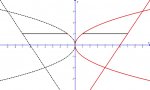
I'm having trouble coming to proper solution.
the problem is:
x=y^2, y=x-6, being revolved around the y-axis
I've made limits on the first integral, from 0 to -6, with the integral being (x+6)^2, multiplied by pi
I've made a second integral, (x+6)^2 - (y^2)^2, with limits 3 to 0, this also being multiplied by pi.
what I come with is ?(1/3y^3 + 6y^2 +36y) limits 0 to -6 plus ?(-1/5y^5 + 1/3y^3 + 6y^2 +36y) limits 3 to 0, but this is not the right answer.
where is my mistake?
the problem is:
x=y^2, y=x-6, being revolved around the y-axis
I've made limits on the first integral, from 0 to -6, with the integral being (x+6)^2, multiplied by pi
I've made a second integral, (x+6)^2 - (y^2)^2, with limits 3 to 0, this also being multiplied by pi.
what I come with is ?(1/3y^3 + 6y^2 +36y) limits 0 to -6 plus ?(-1/5y^5 + 1/3y^3 + 6y^2 +36y) limits 3 to 0, but this is not the right answer.
where is my mistake?