
Volumes by slicing. Volumes of Revolution.

sepoto

New member
Joined
Sep 19, 2013
Messages
16
4b1q.PNG4b1a.jpg
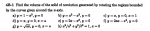
My question is about a)

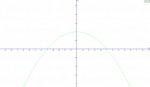
\(\displaystyle y=1-x^2\)

\(\displaystyle \int^1_{-1}\pi\;y^2dx\)

So if I understand correctly the area is being taken between the top of the curve and the x-axis between x=-1 and x=1 but why \(\displaystyle \piy^2\)? I think that \(\displaystyle \pi\) represents a half a revolution but it is not clear to me which axis is the axis of revolution and why is it \(\displaystyle y^2\). Those points are troubling me.

Thanks for any help on this problem...
 
View attachment 3604View attachment 3605
My question is about a)

\(\displaystyle y=1-x^2\)

\(\displaystyle \int^1_{-1}\pi\;y^2dx\)

So if I understand correctly the area is being taken between the top of the curve and the x-axis between x=-1 and x=1 but why \(\displaystyle \piy^2\)? I think that \(\displaystyle \pi\) represents a half a revolution but it is not clear to me which axis is the axis of revolution and why is it \(\displaystyle y^2\). Those points are troubling me.

Thanks for any help on this problem...
I assume you have learned the disk method for finding the volume of a solid revolved about a line, right? You sum up the areas of circles from a to b to achieve the volume. The area of a circle is \(\displaystyle \pi r^2\) so the volume is:

\(\displaystyle V=\int^b_a \pi r^2 dx\)

where r is the radius of the circle taken from the axis of revolution to the function. In this case, \(\displaystyle r=1-x^2\). Since \(\displaystyle y=1-x^2\), then the formula simply becomes:

\(\displaystyle V=\int^b_a \pi y^2 dx\)

You can then subtitute y into the integral and find the values for a and b and have at it. In this case, you have symmetry about the y axis so you could make life a little easier computationally and do the following:

\(\displaystyle V=2\pi \int^1_0 (1-x^2)^2 dx\)

Does this make sense?
 
Well if Y is the radius and \(\displaystyle \pi\;y^2\) is the area of the disk then in the integral:

\(\displaystyle \int^1_{-1}\pi y^2\;dx\)

Why is it being taken from x=-1 to x=1 then. Would it not have to be an integral on the Y-axis from y=0 to y=1?
 
Well if Y is the radius and \(\displaystyle \pi\;y^2\) is the area of the disk then in the integral:

\(\displaystyle \int^1_{-1}\pi y^2\;dx\)

Why is it being taken from x=-1 to x=1 then. Would it not have to be an integral on the Y-axis from y=0 to y=1?
You need to substitute 1-x² in for y in the integral. You can't mix x's and y's in integrals. Whoever showed you the integral \(\displaystyle \int^1_{-1}\pi y^2\;dx\) should have then said what I said, substitute 1-x² in for y and then solve.

Btw, if you wanted to have the integral in terms of y, then you would be using the method of cylindrical shells (which is a different formula than disks) and you would have to solve for x in terms of y and the use y limits on the integral.
 
I think that \(\displaystyle \pi\) represents a half a revolution

Hi. That pi comes from the formula for the area of a circle (pi*r^2); the given region rotates fully around the axis.


it is not clear to me which axis is the axis of revolution

We get the axis of revolution from the instructions ("rotate the regions ... around the x-axis").

The disks are arranged such that the x-axis runs through their centers.


why is it \(\displaystyle y^2\)

y is a symbol for the radius of the disks.

1-x^2 is another expression for the same thing. In other words, it expresses the radii in terms of x instead of y.

As srmichael posted, when integrating along the x-axis, the function being integrated must be in terms of x and followed by dx.

If you integrate with respect to y, then 1-x^2 is no longer a radius (x is now the radius); so, you would need a new expression using y to get those x-coordinates.


If you're still pondering anything in this exercise or thread, keep posting and/or take a second look at your course examples! Cheers :cool:
 
Top