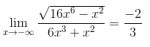
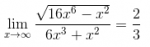
Where am I missing the sign? (radical limits)

Bazoya

New member
Joined
Oct 5, 2016
Messages
5
I have been answering some problems on Khan Academy but I am struggling with finding whether I should be including a negative sign or not. I have read the step-by-step guide on the website which states In the numerator, let's divide by [FONT=KaTeX_Main]-\sqrt{x^6}[/FONT][FONT=KaTeX_Main][FONT=KaTeX_Math]x6minus, square root of, x, start superscript, 6, end superscript, end square root[/FONT][/FONT], since for negative values, [FONT=KaTeX_Main]x^3=-\sqrt{x^6}[FONT=KaTeX_Main][FONT=KaTeX_Math]x3=[FONT=KaTeX_Math]x6[/FONT][/FONT]x, start superscript, 3, end superscript, equals, minus, square root of, x, start superscript, 6, end superscript, end square root[/FONT][/FONT]. but I don't really understand how we know that we must divide by a negative.

. . . . .\(\displaystyle \displaystyle \lim_{x \rightarrow -\infty}\, \dfrac{\sqrt{\strut 16x^6\, -\, x^2\,}}{6x^3\, +\, x^2}\)

Dividing through:

. . . . .\(\displaystyle \displaystyle \dfrac{\sqrt{\strut 16x^6\, -\, x^2\,}}{6x^3\, +\, x^2}\, \cdot\, \dfrac{\frac{1}{\sqrt{\strut x^6\,}}}{\frac{1}{x^3}}\)

Simplifying:

. . . . .\(\displaystyle \displaystyle \lim_{x \rightarrow -\infty}\, \dfrac{4\, -\, \frac{1}{x^2}}{6\, +\, \frac{1}{x}}\)

Therefore:

. . . . .\(\displaystyle \displaystyle \lim_{x \rightarrow -\infty}\, \dfrac{\sqrt{\strut 16x^6\, -\, x^2\,}}{6x^3\, +\, x^2}\, =\, \dfrac{2}{3}\)

However the correct answer is -2/3.

Where should I be including the negative into my working?

Thanks

Jake
 
Last edited by a moderator:
I have been answering some problems on Khan Academy but I am struggling with finding whether I should be including a negative sign or not....

. . . . .\(\displaystyle \displaystyle \lim_{x \rightarrow -\infty}\, \dfrac{\sqrt{\strut 16x^6\, -\, x^2\,}}{6x^3\, +\, x^2}\)

Dividing through:

. . . . .\(\displaystyle \displaystyle \dfrac{\sqrt{\strut 16x^6\, -\, x^2\,}}{6x^3\, +\, x^2}\, \cdot\, \dfrac{\frac{1}{\sqrt{\strut x^6\,}}}{\frac{1}{x^3}}\)

Simplifying:

. . . . .\(\displaystyle \displaystyle \lim_{x \rightarrow -\infty}\, \dfrac{4\, -\, \frac{1}{x^2}}{6\, +\, \frac{1}{x}}\)

Therefore:

. . . . .\(\displaystyle \displaystyle \lim_{x \rightarrow -\infty}\, \dfrac{\sqrt{\strut 16x^6\, -\, x^2\,}}{6x^3\, +\, x^2}\, =\, \dfrac{2}{3}\)

However the correct answer is -2/3.
Think of it this way: if \(\displaystyle x=-10^8\) we have \(\displaystyle \dfrac{\sqrt{(-10^8)^6-(-10^8)^2}}{6(-10^8)^3+(-10^8)^2}<0\) because the numerator is positive while the denominator is negative. That is true for x is approaching negative infinity.
 
Last edited by a moderator:
attachment.php

As x approaches -infinity the answer is -2/3. This is because the numerator is always positive, while the denominator is negative as you move left on the graph. So when a numerator and denominator have opposite signs the result is a negative answer. Try plugging in a very large negative number (like -1,000,000 for x) and you'll see that you'll get a number that's close to -2/3. My math tutor taught me that trick where you plug in numbers.


I also want to point out that as x approaches infinity the answer is 2/3 since the top and bottom end up being positive try plugging in a large number (like 1,000,000 for x) and you'll get a number close to 2/3. Good luck with this.
 

Attachments

  • limit1.png
    limit1.png
    8.9 KB · Views: 12
  • limit2.png
    limit2.png
    8.8 KB · Views: 12
I have been answering some problems on Khan Academy but I am struggling with finding whether I should be including a negative sign or not. I have read the step-by-step guide on the website which states In the numerator, let's divide by [FONT=KaTeX_Main]-\sqrt{x^6}[/FONT][FONT=KaTeX_Main][FONT=KaTeX_Math]x6minus, square root of, x, start superscript, 6, end superscript, end square root[/FONT][/FONT], since for negative values, [FONT=KaTeX_Main]x^3=-\sqrt{x^6}[FONT=KaTeX_Main][FONT=KaTeX_Math]x3=[FONT=KaTeX_Math]x6[/FONT][/FONT]x, start superscript, 3, end superscript, equals, minus, square root of, x, start superscript, 6, end superscript, end square root[/FONT][/FONT]. but I don't really understand how we know that we must divide by a negative.

. . . . .\(\displaystyle \displaystyle \lim_{x \rightarrow -\infty}\, \dfrac{\sqrt{\strut 16x^6\, -\, x^2\,}}{6x^3\, +\, x^2}\)

Dividing through:

. . . . .\(\displaystyle \displaystyle \dfrac{\sqrt{\strut 16x^6\, -\, x^2\,}}{6x^3\, +\, x^2}\, \cdot\, \dfrac{\frac{1}{\sqrt{\strut x^6\,}}}{\frac{1}{x^3}}\)

Simplifying:

. . . . .\(\displaystyle \displaystyle \lim_{x \rightarrow -\infty}\, \dfrac{4\, -\, \frac{1}{x^2}}{6\, +\, \frac{1}{x}}\). .<-- There's a problem here: \(\displaystyle \sqrt{a^2-b^2}\neq a-b\)

Therefore:

. . . . .\(\displaystyle \displaystyle \lim_{x \rightarrow -\infty}\, \dfrac{\sqrt{\strut 16x^6\, -\, x^2\,}}{6x^3\, +\, x^2}\, =\, \dfrac{2}{3}\)

However the correct answer is -2/3.

Where should I be including the negative into my working?

see comment in red
 
Last edited by a moderator:
Top